“Keep running love and trust through your body. Soon even your cells will believe this is their true nature.”
– Penney Peirce
“Keep running love and trust through your body. Soon even your cells will believe this is their true nature.”
– Penney Peirce

Almost every Minnesotan has a Prince story. Some people saw him at a gas station, or they saw him sitting with a lady friend at the Arboretum. One woman knew his hair stylist, and several other people saw him ride his bike around Paisley Park just days before he died. We all want to be part of Prince, and we are proud that he was a Minnesotan.

I am Minnesotan too, and I have a Prince story. Back in 1986, I had the opportunity to see Prince at Paisley Park Studios. I was 15 years old and a fashion model. My agency called me up to ask if I wanted to go to Paisley Park to be part of an audience. Prince filmed the video “Sign O’ the Times” in Paris, but the audience shots didn’t turn out. It was back in the 80’s when we had videotapes. Prince wanted to recreate the lost footage.
I went to Paisley Park to be part of an audience of about a hundred people. Some people were actors, and some were models. Most of us were hired to be there. I received a check from my modeling agency for $80.00.

I spent the whole day at Paisley Park, and I was allowed to bring one friend. We arrived in the morning, and we didn’t leave until about 11:00 PM. The first thing I remember is the waiting and waiting. All hundred of us shuffled into one large garage in the back of Paisley Park. We sat around waiting for our big moment to see Prince and to be part of a live concert.
Lunchtime rolled around, and all of us were starving. Prince’s staff said that they were having technical difficulties, so we had to wait. Prince had a generous spirit, so he hired a McDonalds food truck to come to Paisley Park to hand out burgers, fries, and drinks.
All of us waited until it was dusk. Finally, we were allowed to go into Paisley Park Studios. We had to stand in a line before we entered the stage production area. As we waited in line, Prince walked by us. My friend, Jennifer, and I were surprised how small he was. Prince was a tiny man but so sexy!
Once we entered the stage area, we were told where to stand. Unfortunately, my friend and I stood near the back. If we were to do it all over again, we would have moved up to the front. The stage was a typical stage that you would see at a concert. Prince had his band there too.
The concert was awesome! I was in awe and mesmerized by Prince. He put on a regular show playing all his famous songs. As a crowd, we jumped up and down and did everything the staff asked us to do.
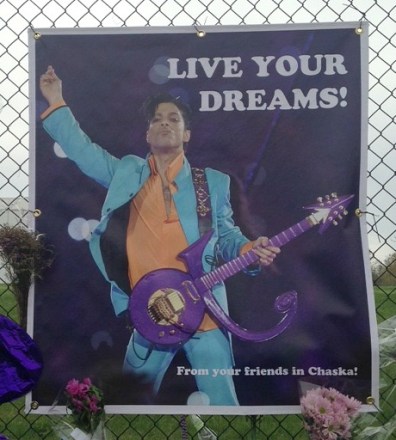
Back in 1986 was my close encounter with Prince. He is and always will be talented and sexy. We will miss Prince. May his music remind us to live our dreams.
Namaste, world.

“Make every day a holy day; start every day with prayer. Fill every day with prayer. End every day with prayer.”
“Do divine! Be divine! It is not enough just to be divine; one must also do divine.”
“Travel light on your journey in life. Your desires and expectations are heavy baggage, which slow you down and thwart your progress. Let them go.”
“Live in PEACE, not in pieces. If you are in peace, you will exude peace, manifest peace, and spread peace. If you’re in pieces, you will manifest pieces and spread pieces.”
“The ‘I’ is the cause of all our problems. It is a wall, a barrier between us and others. Learn to bend the ‘I’ and make it a bridge.”
“WE MUST LEARN to give, give, and give like the sun, and like Mother Ganga, with no hesitation, no expectation, no vacation, and no discrimination.”
“The best way to honor God in our lives is through serving humanity.”
“Meditation is the best medication for all agitations.”
“If we want to be torchbearers of peace, we must first become rivers of love, dousing all flames of discord in the waters of our own compassion and serenity.”
“We must learn to be noiseless amid the noise.”
“Life is about the journey, not the destination. Live in heaven now. Don’t wait for it to come later. Live in moksha (liberation) now. Don’t wait for death.”
“Forgive, forget, and move forward. This is the only way. It is not enough to forgive and forget. One must also move on.”
“One of the keys to a spiritual path is to annihilate the ego, to become humble, to surrender oneself to God.”
“If we set the divine example, others will follow.”
“Prayer is calling back home. It brings us into divine connection.”
“If you cannot be huggy-huggy (full of love) here are Earth, do not expect that hugs will be waiting for you in heaven, learn to be huggy-huggy here on Earth first and then this Earth will become your heaven.”

Namaste, world.
“To say that we must have but one life here with such possibilities put before us and impossible to develop is to make the universe and life a huge and cruel joke.” – Ven. K. Sri Dhammananda (Buddhist Monk)
I am training for my next life. Of course, someone might object that we have more than one lifetime. But I believe that each soul has had many lives. Furthermore, I understand my mortality, and I have a very short time, in this life, to develop wisdom. I am half way through my lifetime if I live to be in my eighties. The universe is opening my eyes and helping me live with intention and intuition.
I remember my good friend, Jumba. He died of pancreatic cancer a year and a half ago. Jumba taught Tai Chi at Triple Gem of the North (TGN) Mindfulness Center, and I currently teach yoga at the center. I attended his Tai Chi classes, and he attended my yoga classes. I was always impressed with his flexibility as he sat in full lotus pose.
Jumba was a joyful man. He was always happy and energetic. He was married and had four children. His illness appeared quickly, and he lived only four months after his diagnosis. While he was in the hospital, he told Bhante Sathi, the Sri Lankan monk at TGN Mindfulness Center, that he wanted to live in Sri Lanka as a monk in his next life.

Where do I want to live in my next life? Who do I want to be? Can I prepare for my next life while I live my current life? In his book, “What Buddhists Believe,” Ven. K. Sri Dhammananda maintains that, “In the process of self-transformation, a person will no longer aspire for a divine birth as his ultimate goal in life. He will then set his goal much higher, and model himself after the Buddha, who has reached the summit of human perfection and attained the ineffable state we call Enlightenment or Nibbana.”
A few weeks ago, when I was in Sedona, Arizona, I realized that I am not ready to leave this life. I still have a lot of spiritual work to do. This work is crucial, and I must not take my life for granted! I know that I am not ready for Enlightenment or Nibbana, but I am making spiritual progress.
According to Ven. K. Sri Dhammananda, “Man can be enlightened – a Buddha – if he wakes up, from the ‘dream’ that is created by his own ignorant mind, and becomes fully awakened. He must realize that what he is today is the result of an untold number of repetitions in thoughts and actions. He is not ready-made: he is continually in the process of becoming, always changing. And it is in this characteristic of change that his future lies, because it means that it is possible for him to mold his character and destiny through the choice of his actions, speech and thoughts. Indeed, he becomes the thoughts and actions that he chooses to perform. Man is the highest fruit on the tree of evolution. It is for man to realize his position in nature and to understand the true meaning of his life.”
I like the quote: “He must realize that what he is today is the result of untold number of repetitions in thoughts and actions.” We are responsible for what we think and what we do. These thoughts and actions shape who we are as human beings. We are a product of energy; mind and body.
Here are some self-transforming key points that I recommend, by Rick Hanson, Ph.D., “Buddha’s Brain: The practical neuroscience of happiness, love, and wisdom:”
Namaste, world.
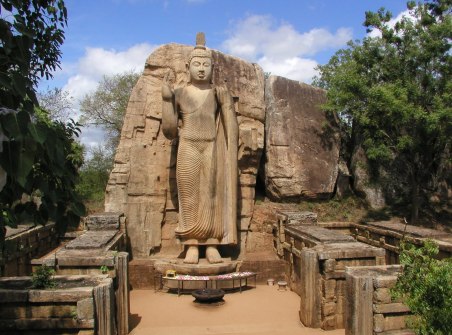
Those who really seek the path to Enlightenment
dictate terms to their mind. They then proceed with
strong determination. – Buddha
If light is in your heart, you will find your way home. – Rumi
Don’t throw anyone out of your heart. – Sharon Salzberg

Om or Aum is a sacred sound and symbol. Om is the universal sound; the first sound of creation. In the yoga sutras by B.K.S Iyengar (1993), “Aum is called Pranava, which stands for the praise of the divine and fulfillment of divinity.” Iyengar continues to say, “Sound is vibration, which as modern science tells us, is the source of all creation. God is beyond vibration, but vibration, being the subtlest of His creation, is the nearest we can get to Him in the physical world. So we take it as His symbol.”
I have been using Om in my pranayama practice. Yogic breathing is called pranayama in Sanskrit. Brown et al., (2005) defines pranayama as “meaning both control of energy and expansion of energy” (p. 189). In other words, Brown says that the breath is energy, and we have control over it. Brown (2005) states, prana is defined as breath or life force. According to Iyengar (1996), “pranayama by nature has three components: inhalation, exhalation, and retention. They are carefully learned by elongating the breath and prolonging the time of retention according to the elasticity of the torso, the length and depth of breath and the precision of movements” (p. 33). Iyengar’s point is to learn to hold the breath for longer periods of time to increase the volume oxygen in the body.
Breath links the body and mind. Yogic breathing techniques can be used to balance the autonomic nervous system and have a positive effect on stress-related disorders. When individuals are under stress, they restrict their breathing and decrease the amount of oxygen coming into their bodies (Wilkinson, 2002). Yogic breathing techniques increase the volume of oxygen in the lungs and help the body to relax and the mind to focus.
When I chant Om, I repeat it three times with a long expiration. Chanting Om has complex effects on the brain; especially in the Wernicke’s area and the thalamus (Brown, 2005). According to Brown et al., (2005), “Even just mentally chanting Om showed decreased metabolism, decreased heart rate, and increased peripheral vascular resistance in seven experienced yogic meditators” (p. 195). Chanting Om also increases synchronicity of particular biorhythms in the brain (Zope, 2013). D’Antoni et al.(1995) state that “mantra production frequently employs the phonemes, m, and n, which are thought to evoke pleasant association and a feeling of release” (p. 309). The chant Om has the phoneme m in it.
Om is magical. I have experienced its effects on my mind and body. I am an emotional person and sometimes I have a difficult time controlling my emotions. According to The Art of Living Foundation (http://www.artofliving.org), “rather than allowing the emotions to alter the breath (and cause physiological changes which may prove unhealthy), one can skillfully use the breath to transform one’s emotional state.” When someone is angry, the breath is short and quick. And when someone is sad or upset, the breath is long and deep. Om can be used to control the breath and balance the emotions.
I had a little health scare this past month. I found a few pink, scaly spots on my face. I was worried that I might have skin cancer. So last week I went to the dermatologist. I made a plan that I would silently use the Om chant while I sat in the office, and during the consultation and treatment. I was surprised how chanting Om helped me to be calm and feel centered. I did not get upset, and my heart rhythm was strong.
I found out that I do not have skin cancer. I have Actinic Keratoses. It’s a common skin disorder from years of sun exposure. Actinic Keratoses is considered precancerous. If left untreated, Actinic Keratoses may turn into squamous cell carcinoma. I am treating my spots (with liquid nitrogen), so hopefully I will not get skin cancer.
I can count on the magic of Om to balance the biorhythms in my brain and in my heart. I have to admit; I was scared that I was going to die from skin cancer. Deep breathing and prayer helped me connect with God and the universe. Life can be scary, so we need to learn to breathe through it.
Namaste, world.
References
Brown, R.P., & Gerbarg, P.L., (2005). Sudarshan kriya yogic breathing in the treatment of stress, anxiety, and depression: Part I – Neurophysiologic model. The Journal of Alternative and Complementary Medicine, 11(1), 189-201.
Brown, R.P., & Gerbarg, P.L., (2005). Sudarshan kriya yogic breathing in the treatment of stress, anxiety, and depression: Part II – Clinical applications and guidelines. The Journal of Alternative and Complementary Medicine, 11(4), 711-717.
D’Antoni, M., Harvey, P., & Fried, M. (1995). Alternative medicine: Does it play a role in the management of voice disorders. Journal of Voice, 9(3), 308-311.
Iyengar, B.K.S. (1966). Light on yoga. New York, NY: Schocken Books, Inc.
Iyengar, B.K.S. (1993). Light on the Yoga Sutras of Patanjali. Hammersmith, London: HarperCollins Publishers.
Wilkinson, L., Buboltz, W. C., & Young, T. (2002). Breathing techniques to promote client relaxation and tension reduction. Journal of Clinical Activities, Assignments & Handouts in Psychotherapy Practice, 2(1), 1-14.
Zope, S.A., & Zope, R.A., (2013). Sudarshan kriya yoga: Breathing for health. International Journal of Yoga, 6(1), 4-10.
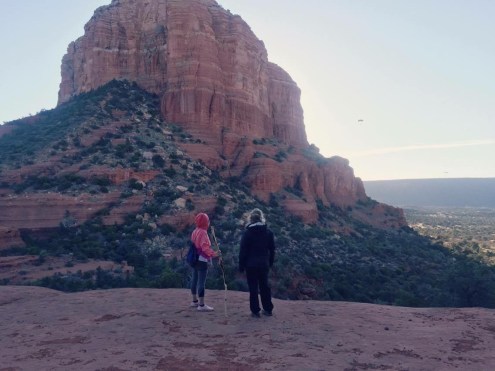
I just went on a spiritual pilgrimage to Sedona, Arizona. And now that I am back, I can reflect on my experience. I ask myself the questions: What is a spiritual pilgrimage? What was I seeking? And what did I learn?
According to eHow, a spiritual pilgrimage is a physical journey toward a place of sacred or religious significance. Sedona attracts people from all over the world to experience its vortexes and holy land. Many people travel to Sedona for healing and to evolve their consciousness. The red rocks contain minerals of quartz, copper and iron; both hold healing properties. Copper magnifies energy and opens up the chakras. And iron, like in our blood, creates balance in the body and mind.
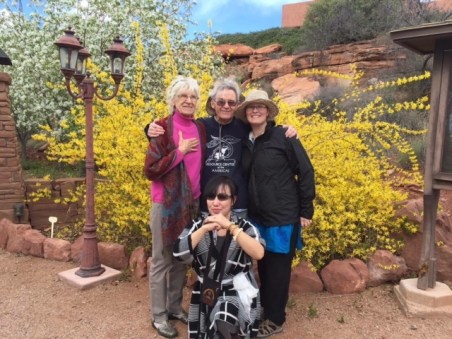
I traveled with three other spiritual seekers: Sister Lucy is a Franciscan nun, Joe studied Shamanism in Peru, and Trina is a Vietnamese energy healer and medical interpreter. Our group theme for the trip: trust and let go. We trusted God to guide us.
What was I seeking? I was seeking spiritual transformation. My first transformation was at the Chapel of the Holy Cross. This beautiful, little Catholic church was built in the red rocks. When I entered the chapel, I felt the presence of God. I could feel the energy of thousands of past visitors. As I sat on the simple wooden bench, I felt the mercy of God. The love and forgiveness of God swelled in my heart. God has mercy for all.
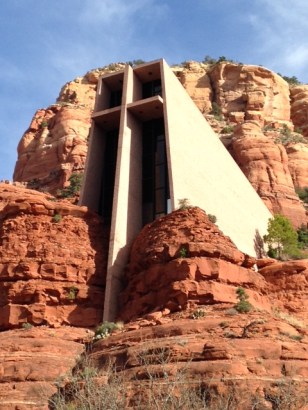 Chapel of the Holy Cross
My next transformation was at the Amitabha Stupa and Peace Park. A stupa is a Buddhist shrine. The park holds a large wooden statue of Buddha, a medicine wheel, and two Stupa’s; one masculine and one feminine. As I walked the grounds, my heart opened up like never before. I could feel my heart chakra – it was turning and turning. I couldn’t help but to cry. I could feel every wound that I have ever experienced in my life. I was grieving and letting go at the same time. I was purging everything that no longer serves me.
I had to walk by myself to process my feelings. I walked down to a ravine. I sat and meditated. As I sat on the grass, I could feel spirits all around me. I was not alone. I am never alone.
After spending some time by myself, I joined the group. We walked the medicine wheel. I connected with the energy and sacredness of our group.


That evening (after visiting the Stupa), in my hotel room, I had an unusual experience. I was sleeping until a loud bang woke me up. The noise seemed to come from the wall. I thought maybe it was the pipes. Then I heard another noise near the bathroom. The noise was loud, and my body jumped when I heard it. Then I heard it, again, near the television. It was like energy was bouncing off the walls. The last bang that evening was two feet above my head near the headboard. I have never experienced anything like this before. I was scared. I had to breathe deeply and call on my guides.
I did not hear any banging noise during the rest of the trip. It is a mystery – I don’t know what was banging. I did feel challenged, and there is one lesson that I learned from this: I need a strong mind. I can develop a powerful mind through meditation and breathing exercises.
When I was on this trip, I thought a lot about relationships. It’s interesting that no matter where we are in life, our relationships come first before anything else. I remember hearing a story about a counselor who went to Haiti after the earthquake. She was there to help people process the tragedy but all the people wanted to talk about was their relationships.
At the end of the trip, I started to miss my husband. I realized that I have one person who cares about me and is there for me. Sedona has opened my eyes. I now see that I have taken my marriage for granted. I treasure my husband, and I want to become a more loving wife.
My next spiritual transformation was with a Native American guide. Joe, Trina, and I hired a Native American guide to talk about the land and lead us on a shamanic journey. We laid down on the warm, red rock as the Native American guide drummed for us. He told us to envision a bridge to a mountain. And when we got to the mountain, we would see a cave. He said that there was a bright light coming out of the cave, and inside the cave was a gift.
During my journey, I imagined a rope bridge that was partially invisible. When I arrived at the mountain, I saw the rock cave and a bright light coming out of it. I walked into the cave and saw a red, rectangle box on a table in the middle of the cave. I opened the box and a cosmic egg made of light surrounded me. This light balanced all of my chakras. Then I saw my wolf guide standing by the box. I asked the wolf his name. The wolf took his paw and wrote in the sand: SHIVA.
The Native American told me that it is a blessing to have the wolf as my guide. The wolf is a protector and leader. The wolf is good medicine.
 Mitakuye Oaysis – All my relations
Now that I am home, I am still in spiritual transformation. My heart is still opening up, and I can feel the holy fire of love igniting in my heart. I need to let this fire warm up my whole being and allow myself to feel. As one Sedona resident said to me, “It’s okay to feel.”
I trust God. Even though there is heartbreak in life, there is also beauty. I ask myself, “What do I want to see?” I am the artist of my life. What am I going to paint?
Sedona is a sacred place, and the vortexes are real. This energy of the vortex spins the heart chakra open. There is no hiding in Sedona. This holy place wants you to feel – to your core.
Namaste, world.
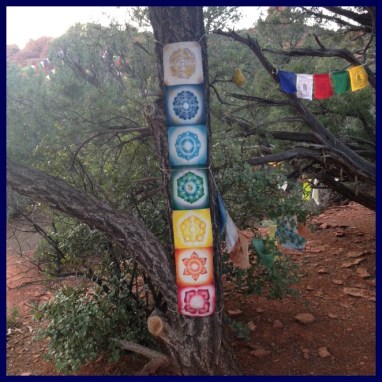

About two weeks ago, my mom was having health problems, and I had to call 911. It’s been about ten years since I called 911. I was a little shaken because my mom couldn’t walk. As I talked to the 911 operator, she told me, “Take some deep breaths.” I did as she asked and I felt much better afterwards. I just needed to hear those words: take some deep breaths.
In this emergency situation, my deep breathing was different than I expected. I inhaled into my nostrils and exhaled out my mouth. I remember puckering my lips as I exhaled – like blowing out candles. After breathing deeply, I was able to gain composure and continue with the call.
Deep breathing increases oxygen to the whole body. It is best to use the respiratory system to its fullest; especially in stressful situations. Deep breathing relaxes the body and mind.
Here is a breathing technique to help you reduce your stress and anxiety:
Deep Nostril Breathing and Mouth Exhalation Technique (taken from “Science of Breath: A Complete Manual of the Oriental Breathing Philosophy of Physical, Mental, Psychic and Spiritual Development,” by Yogi Ramacharaka):
I hope I will never have to call 911 again. But if I do, then I will remember to “take some deep breaths.” I know that increasing oxygen in my body will help me face the challenge before me.
May you go forward in peace.
Namaste, world.
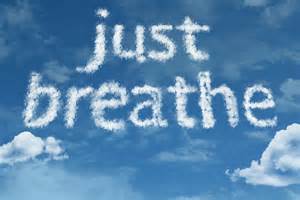
Your breath touched my soul and I saw beyond all limits. —Rumi
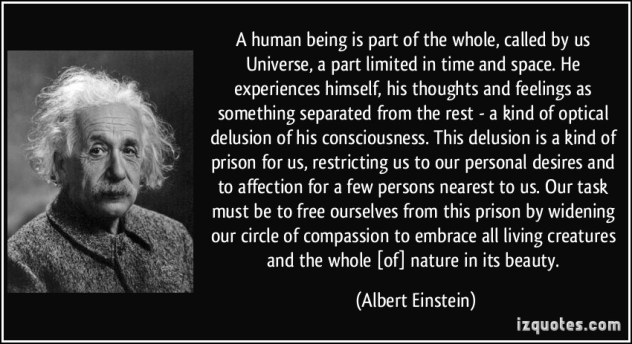
I like this quote written by Albert Einstein. It is true, we will never spiritually grow as a human species if we only love our circle of friends and family. I think we need to expand our thoughts and actions. On Facebook there is a quote by Coco Chanel:

The quote says, “I don’t think about you at all.” This statement is untrue. The mind thinks about EVERYTHING! As a human species, we need to stop and use our thoughts for the higher good. The ego will run with selfish thoughts.
I think the quote should say: “I care about you, and I think about you.” This quote shows more love and concern. The quality of the quote has a higher vibration. Also, there is more inclusion. The original quote has exclusion and harshness.
In Buddhism, there is a word called, “Metta.” In English, it means “loving-kindness.” But there is another translation that has a higher spiritual resonance: “active interest in others.” When you show someone that you care about them and think about them – this is true Metta. Your presence and compassion create the spiritual leap we need as humans.
When I walk down a busy street, and I make no eye contact with other humans – this is not Metta. When I walk down a street, and I make eye contact and chat with strangers – this is Metta.
When my coworker’s mother was just in the hospital, and I do not show concern or ask questions – this is not Metta. When my coworker just attended a funeral, and I express concern, ask questions, and offer help – this is Metta.
Metta is a priceless treasure that brings us into intimacy with ourselves and others. – Sharon Salzberg
I have been practicing Metta for several weeks now. My main area of focus is in my work as a massage therapist. I have taken the time to show concern and ask questions about my clients. I decided not to talk about myself unless the client asks me questions. I put my whole focus on my clients.
There are several things that I noticed when I practice Metta. First, I enjoy asking questions and getting to know my clients (many who are strangers). Second, I look forward to going to work because I am making a difference in people’s lives. And third, when I practice Metta, life is much more vibrant and loving.
Metta reunites us with what it means to be alive and unbound. – Sharon Salzberg
May you share your Metta with all living creatures.
Namaste, world.

Wonder Warrior
coat of armor
heart of steel
mix of confidence
facing what is real
Wonder Warrior
choice of bravery
one step forward
one step again
Wonder Warrior
you are the one
chosen woman
wonder woman
 Tunnel Vision 8