Buddhism
Judgement

Remember, only you decide who is qualified to judge you. – Buddhist Monk Bhante Sathi
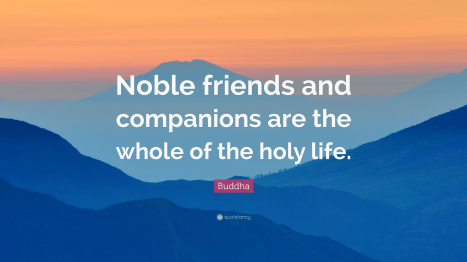
Noble Friends

In the world of Facebook, do we need to be friends with everyone? The answer is no. It’s important to have noble friends. Noble friends are the kind of friends who are virtuous, positive and follow a healthy lifestyle. These friends look out for your best interest and care about you.
Merriam-Webster defines noble as someone who has fine personal qualities or high moral principles and ideals. James Allen, a British author, says, “A noble and Godlike character is not a thing of favour or chance, but is the natural result of continued effort in right thinking, the effect of long-cherished association with Godlike thoughts.”
A noble person is also friendly and kind towards everyone. Kindness is a wish for others to be happy. Rick Hanson, the author of “Buddha’s Brain,” says that “compassion responds primarily to suffering, but kindness comes to play all the time, even when others are doing fine.” The word “kind” comes from the root word “kin” which means family or relations. When we are kind, we bring people into the circle of “us.”

Buddhist monk Bhante Sathi (www.triplegem.org) says noble friends support each other on the path to wisdom. One of the steps to wisdom is right action. Thich Nhat Hanh, in his book, “The Heart of the Buddha’s Teaching,” describes the right action as “the practice of touching love and preventing harm, the practice of nonviolence toward ourselves and others.” The fundamental principle of right action is to do everything with mindfulness.
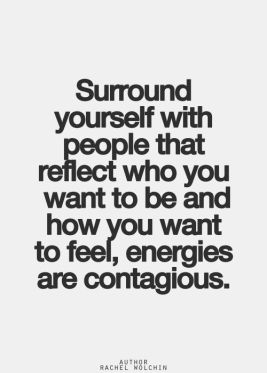
Facebook is a great tool to keep in touch with family and friends. However, some posts are more positive than others. It’s crucial to keep Facebook friends that lift your spirits and inspire you. Look for noble friends in the cyber world and in everyday life. Just like the quote at the top, it’s crucial to surround yourself with people that reflect who you want to be and how you want to feel. Seek people who have the qualities that you would like to have.

Namaste, world.
Meditation is Simple!

“Life is complicated, but meditation is simple.” – Bhante Kamalasiri (www.triplegem.org)
Life can be complicated. We have our jobs, bills to pay, children and elderly parents to take care of, household tasks, etc. But meditation is simple! When we sit on the cushion, we must remember not to make it complicated. Just sit on a cushion or a chair, close your eyes, and watch your present breath. If thoughts come into your head, just observe them, and then return your attention back to your breath. Don’t worry if you’re not doing it correctly or not sitting long enough. Just sit. Make it simple!
Namaste, world.
Training for My Next Life

“To say that we must have but one life here with such possibilities put before us and impossible to develop is to make the universe and life a huge and cruel joke.” – Ven. K. Sri Dhammananda (Buddhist Monk)
I am training for my next life. Of course, someone might object that we have more than one lifetime. But I believe that each soul has had many lives. Furthermore, I understand my mortality, and I have a very short time, in this life, to develop wisdom. I am half way through my lifetime if I live to be in my eighties. The universe is opening my eyes and helping me live with intention and intuition.
I remember my good friend, Jumba. He died of pancreatic cancer a year and a half ago. Jumba taught Tai Chi at Triple Gem of the North (TGN) Mindfulness Center, and I currently teach yoga at the center. I attended his Tai Chi classes, and he attended my yoga classes. I was always impressed with his flexibility as he sat in full lotus pose.
Jumba was a joyful man. He was always happy and energetic. He was married and had four children. His illness appeared quickly, and he lived only four months after his diagnosis. While he was in the hospital, he told Bhante Sathi, the Sri Lankan monk at TGN Mindfulness Center, that he wanted to live in Sri Lanka as a monk in his next life.

Where do I want to live in my next life? Who do I want to be? Can I prepare for my next life while I live my current life? In his book, “What Buddhists Believe,” Ven. K. Sri Dhammananda maintains that, “In the process of self-transformation, a person will no longer aspire for a divine birth as his ultimate goal in life. He will then set his goal much higher, and model himself after the Buddha, who has reached the summit of human perfection and attained the ineffable state we call Enlightenment or Nibbana.”
A few weeks ago, when I was in Sedona, Arizona, I realized that I am not ready to leave this life. I still have a lot of spiritual work to do. This work is crucial, and I must not take my life for granted! I know that I am not ready for Enlightenment or Nibbana, but I am making spiritual progress.
According to Ven. K. Sri Dhammananda, “Man can be enlightened – a Buddha – if he wakes up, from the ‘dream’ that is created by his own ignorant mind, and becomes fully awakened. He must realize that what he is today is the result of an untold number of repetitions in thoughts and actions. He is not ready-made: he is continually in the process of becoming, always changing. And it is in this characteristic of change that his future lies, because it means that it is possible for him to mold his character and destiny through the choice of his actions, speech and thoughts. Indeed, he becomes the thoughts and actions that he chooses to perform. Man is the highest fruit on the tree of evolution. It is for man to realize his position in nature and to understand the true meaning of his life.”
I like the quote: “He must realize that what he is today is the result of untold number of repetitions in thoughts and actions.” We are responsible for what we think and what we do. These thoughts and actions shape who we are as human beings. We are a product of energy; mind and body.
Here are some self-transforming key points that I recommend, by Rick Hanson, Ph.D., “Buddha’s Brain: The practical neuroscience of happiness, love, and wisdom:”
- What happens in your mind changes your brain, both temporarily and in lasting ways; neurons that fire together wire together. And what happens in your brain changes your mind, since the brain and mind are a single, integrated system.
- Therefore, you can use your mind to change your brain to benefit your mind – and everyone else whose life your touch.
- People who have practiced deeply in the contemplative traditions are the “Olympic athletes” of the mind. Learning how they’ve trained their minds (and thus their brains) reveals powerful ways to have more happiness, love, and wisdom.
- The brain evolved to help you survive, but its three primary survival strategies also make you suffer.
- Virtue, mindfulness, and wisdom are the pillars of everyday well-being, personal growth, and spiritual practice; they draw on the three fundamental neural functions of regulation, learning, and selection.
- The path of awakening involves both transforming the mind/brain and uncovering the wonderful true nature that was there all along.
- Small positive actions every day will add up to large changes over time, as you gradually build new neural structures. To keep at it, you need to be on your own side.
- Wholesome changes in the brains of many people could tip the world in a better direction.
Namaste, world.
Those who really seek the path to Enlightenment
dictate terms to their mind. They then proceed with
strong determination. – Buddha
Metta for All

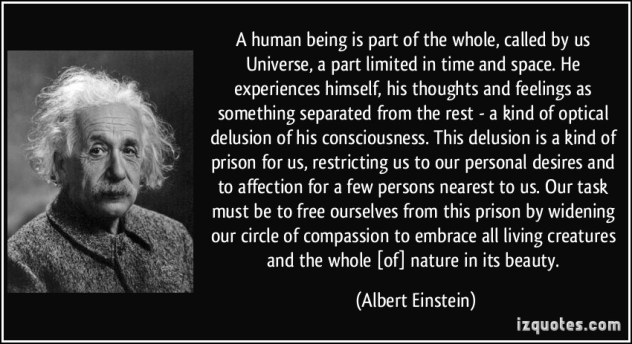
I like this quote written by Albert Einstein. It is true, we will never spiritually grow as a human species if we only love our circle of friends and family. I think we need to expand our thoughts and actions. On Facebook there is a quote by Coco Chanel:

The quote says, “I don’t think about you at all.” This statement is untrue. The mind thinks about EVERYTHING! As a human species, we need to stop and use our thoughts for the higher good. The ego will run with selfish thoughts.
I think the quote should say: “I care about you, and I think about you.” This quote shows more love and concern. The quality of the quote has a higher vibration. Also, there is more inclusion. The original quote has exclusion and harshness.
In Buddhism, there is a word called, “Metta.” In English, it means “loving-kindness.” But there is another translation that has a higher spiritual resonance: “active interest in others.” When you show someone that you care about them and think about them – this is true Metta. Your presence and compassion create the spiritual leap we need as humans.
When I walk down a busy street, and I make no eye contact with other humans – this is not Metta. When I walk down a street, and I make eye contact and chat with strangers – this is Metta.
When my coworker’s mother was just in the hospital, and I do not show concern or ask questions – this is not Metta. When my coworker just attended a funeral, and I express concern, ask questions, and offer help – this is Metta.
Metta is a priceless treasure that brings us into intimacy with ourselves and others. – Sharon Salzberg
I have been practicing Metta for several weeks now. My main area of focus is in my work as a massage therapist. I have taken the time to show concern and ask questions about my clients. I decided not to talk about myself unless the client asks me questions. I put my whole focus on my clients.
There are several things that I noticed when I practice Metta. First, I enjoy asking questions and getting to know my clients (many who are strangers). Second, I look forward to going to work because I am making a difference in people’s lives. And third, when I practice Metta, life is much more vibrant and loving.
Metta reunites us with what it means to be alive and unbound. – Sharon Salzberg
May you share your Metta with all living creatures.
Namaste, world.