About a week ago, I read about a woman who worked at Disney World for over 30 years. She said she noticed a big change in today’s children. She noticed children on cell phones, not even looking up. They were visiting the most magical place on earth, yet not participating. What kind of memories are children creating? Just online shorts and nothing real?
Cell phones foster passive participation rather than active participation. Humans are watching and listening to other people and events. Before cell phones, we actively participated in life. We didn’t just watch things on a device.
We need to define what it means to be human. Also, we need to ask, “How can we live our lives to the fullest? And “What takes away from our precious time?”
The cell phone literally pacifies us. We go on it for entertainment and relaxation. But we need to be careful not to let it take away from living life. Screens also dull the mind and train the brain to accept a mediocre life. Humans are so distracted that they accept not being fully present in life.
And, more importantly, we must allow our children to participate fully in life. They need movement and to engage the senses. Every time they look down at their phone, they miss out on living out their childhood and being in the present moment. A human child needs to communicate, play, dream, and create.
The Internet is just like Disney World. It wants our engagement so it can make money. But to participate, we have to follow their rules. Tech companies have spent billions of dollars to find ways to capture our attention.
The system is set up in their favor, not ours. But we still have a choice about whether we want to play. We are at the crossroads, right now, to still have a choice. We need to make some big decisions on how we want to interact with screens and technology.
The Buddhist Metta Sutta tells a story about 500 monks who went into the jungle to practice meditation:
Approximately 500 monks who had gone into the jungle to practice meditation were disturbed and frightened by certain spirits. Whereupon they returned and reported the matter to the Buddha. The Buddha then advised the monks to return to the same place, armed with the sword of Metta (loving-kindness) for their protection.
The monks returned to the jungle and radiated their lovingkindness to the jungle and those spirits. Thereafter, they continued with their meditation without any hindrance. These same spirits who had earlier created disturbances later repented and paid their respects to the monks.
This is, therefore, an important Sutta to recite and radiate your loving-kindness to every living being. By doing so, you can overcome any disturbances, find peace and happiness, and help others live peacefully by practicing this great virtue. (From the book, “Daily Buddhist Devotions, by Venerable K Sri Dhammananda.)
Lately, I’ve been practicing a loving-kindness meditation at night, before I go to sleep, or in the morning before I get up. Here is the meditation: Loving-Kindness Meditation: To begin, you can sit or lie down. When you are comfortable, take a deep breath. Feel your breath expand the body, and then relax. Focus on the words “loving-kindness” in your heart (chest area). At first, do not think about sending loving-kindness to anyone – just feel the love in your heart. Let there be space in your mind. After a few minutes of focus, you can expand the loving-kindness to yourself, your family and friends, pets, and all living beings. You can close the meditation by bringing your palms together, creating a sense of balance in the body. Or you can rest your hands on your chest.
In this turbulent world, how do you keep calm and loving? How do you protect yourself from outside energy and influences? Please leave a comment (see above near the title).
I just got back from a 11-day ayahuasca retreat in Tarapoto, Peru. I was nervous about going on the retreat because I would be far from home and experimenting with an unknown plant medicine. I remember my husband, Jeff, saying to me before I left, “Don’t do anything stupid.”
A week before I went to Peru, I stopped by my parents’ grave marker and asked them to keep me safe while I was there. And now that I’m back, I feel like I was protected.
The retreat center is on the edge of the regional conservation of Cordillera (the edge of the Amazon). The lush forest is full of animals, birds, and insects. At night and during the day, I could hear different kinds of birds, roosters, monkeys, and coyotes. The forest is never quiet. The mosquitoes were out in full force, and they loved me!
The goal of the Ayahuasca retreat is a purify the physical, mental, and spiritual bodies so Mother Ayahuasca can do her work. The main reason to do ayahuasca is to become strong and experience transformation. Many people want to seek solutions to their depression, physical aliments, and drug addictions.
During the retreat, eight other participants and I followed a strict diet (no oil, salt, sugar, or meat) and a digital detox (no cell phone for eight days). We weren’t allowed to use beauty or bath products. To keep the mosquitoes away, we used a natural citronella spray.
I had several conflicts about taking ayahuasca. First, I don’t like taking psychedelics. And second, as a Buddhist, I’m not allowed to take any intoxicants. Honestly, I had doubts as soon as I arrived at the retreat center. I wish I had gone on the yoga retreat instead.
The retreat felt more like an “ayahuasca boot camp.” Many times, I felt peer pressure to take ayahuasca. The shamans treated ayahuasca like liquid gold, and it would cure everything. However, as a tourist and Westerner, I did not grow up in the Amazon. My relationship with plants is different—I didn’t grow up drinking ayahuasca like the shamans did.
I was also given a second plant medicine called “Boa Waska.” The shaman said it will help me open my chakras (the boa is like the kundalini). I was instructed to take it in the morning and before sleeping. It tasted like dark rum. I ended up taking it occasionally.
During the retreat, there were four ayahuasca ceremonies (two during the day and two at night). The first ceremony was at night. I remember feeling anxious about taking ayahuasca. A black and orange butterfly landed on my shoulder as I walked along the path from the cafeteria. I took it as a good sign – that I would be okay with my first ayahuasca ceremony. The butterfly is one of my spirit guides.
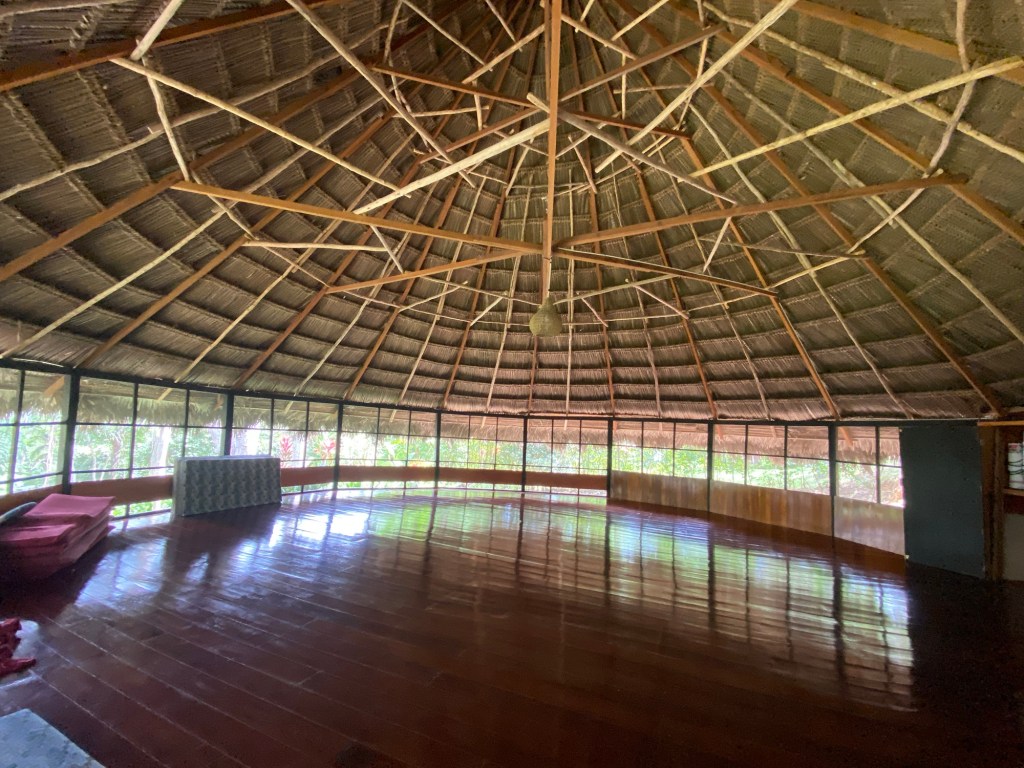
The ceremonies were held in a large circular building called a “maloca.” Each person had two mats, a pillow, and a blanket. There was also an ice cream bucket and a roll of toilet paper. Before I entered the maloca, I was smudged with tobacco smoke. There were two shamans and four helpers. The helpers brought people to the bathrooms or filled their water bottles.
Maloca – gathering place for ceremonies
We all began on our mats. Each person was offered Rape (a powdered combination of dried tobacco, ash, and herbs administered up the nose) and special eye drops. I tried Rape up only my left nostril and I didn’t do the eye drops. Then, each person, one by one, went up to take the cup of ayahuasca. When I went up, the shaman asked me how I was feeling and how much I wanted to take. I said, “I am nervous. I want a small amount.” Ayahuasca is mixed with chacruna, and it tastes like thick molasses.
Then I went back to my mat to meditate. The ayahuasca made me feel dizzy with a mild burning sensation in my stomach. Most people take enough ayahuasca that they eventually vomit or have diarrhea. Ayahuasca creates an inner volcano that eventually erupts.
I sat and cried a little after repeating, in my mind, “Mama Ayahuasca.” I was crying because when I said, “mama,” it reminded me of my mom who recently passed away.
Eventually, I received the message to let my mom and dad go. It was time, and I didn’t want to hold them back energetically. Then I had a vision. I saw a gold cross in a tunnel, and my parents were walking towards it. It was a peaceful image, and it made sense that I saw a cross, given that my parents were Catholic. However, the cross is seen all over the world. The cross has a Christian meaning, but it can also represent the human body, the four cardinal directions, eternal life, female anatomy, the chakras, and the union of heaven and earth.
My vision during the ayahuasca ceremony (AI generated from my sketch).
During each ceremony, the shaman sings Icaros – magical songs. The shaman comes to each person to sing directly to them (for about 15 minutes). I hummed along to open up my chakras, especially my throat chakra.
After the ceremony, I had a headache and I felt slightly nauseous. When I lay down to sleep, my heart was racing. I felt anxiety, and I wished I hadn’t taken ayahuasca.
That night, I dreamt that an older shaman gave me medicine in cream-colored powder. The shaman had straight black hair in a bob and was dressed in colorful traditional clothing. My dreams, during the retreat, were vivid and memorable.
The second ayahuasca ceremony was during the daytime. I decided to hold the cup but not drink the ayahuasca. However, as I sat on my mat, I could feel the energy of the people around me. I kept reminding myself to “keep my health and follow my intuition.”
On Sunday night, June 8, I dreamed of an ambulance with lights flickering passing me by. When the ambulance stopped, I looked into it and saw my dog, Liam, on the stretcher receiving help from the paramedics. He was still alive but not doing well. Then, on Monday morning, the shaman said my husband had called last night, and she told him I would call him back in the morning.
Jeff said Liam was acting weird and falling over. I told him to bring Liam to the vet. Later, Jeff said Liam was struggling to breathe, and he had to put him to sleep. It was the first time I’ve ever heard my husband cry. I cried, too. I felt so sad.
My dog, Liam, was a 14 years old miniature schnauzer. He was on medication and was declining for several months. I knew he might not live too much longer. I felt super sad for the rest of the retreat, but I decided to stay calm and stay in the present moment. I didn’t want to always be sad and bring people down. Unfortunately, grief was my companion during the retreat.
The Buddhist Salla Sutta states that wailing does not attain peace of mind. It only brings grief and hurt to the body. Mourning only makes the mourner emaciated and pale. It does not help the departed. Therefore, mourning is meaningless.
The Salla Sutta continues by saying that even if humans were to live a hundred years or more, they must still yield to their lives, at last bereft of friends and relatives. Therefore, listening to the wise and the holy and seeing a beloved one departed, control your weeping. Reflect on the departure of your beloved ones by thinking that separation is natural.
We grieve because we love.
During the next few days, I realized I needed to be in control. And I have a lot of fear about my health. My roommate, Rosanne, said maybe it’s because I see dying people all the time (in my work as a hospice massage therapist). I get too concerned about my body moment by moment. It’s hard to let go. I wanted to remain in homeostasis.
The shaman said I must be more “child-like” and let go. I need to trust. But I have difficulty trusting people, especially since I am far from home. I have travelled all around the world, and I have seen people get sick, and it’s not fun.
I kept telling myself, “I must be strong and healthy” – nothing can disturb my commitment. I will let go of taking ayahuasca to remain stable.
The third ayahuasca ceremony was during the day. Again, I held the cup and prayed for my family, friends, and pets. The fourth and final ayahuasca ceremony was at night during a full moon. I decided to take a small sip. I wanted to have the plant medicine in me – to give it a chance.
Sitting on my mat, I imagined using sign language to communicate with Mother Ayahuasca. I read somewhere that Mother Ayahuasca likes to communicate in images. I signed to her in my mind, “Show me what I need to know.” I know that ayahuasca will continue to work with me in the months to come.
When I thought about what makes a good shaman, I thought of my mentor, Sister Lucy Bruskiewicz, who passed away in 2022. She deeply cared about people and honored them. She never forced things and met people where they were in life. I hope I can follow her example.
I learned a lot from the ayahuasca retreat. For example, I learned to stand on the ground despite being shaky. I saw my weaknesses and knew I wanted to improve myself. I also realized that I am strong amid peer pressure. I want to work on loving-kindness toward myself and others.
The retreat restored a sense of gratitude in my heart. I am so thankful for my health, my devoted husband, my beautiful family and friends, loyal cat, and my country.
I am happy to be home. I was born in St. Paul, Minnesota. Like shamans worldwide, I can reconnect with the land around me and learn about medicinal plants. I am home, sweet home.
I am starting to understand the Buddhist terms of “impermanence” and “openness.” I recall telling my Buddhist teacher, during tea time, that I exist and I don’t exist, and that there is a lot of freedom because I don’t exist. My teacher said, “No, that’s not correct. You do exist.” I felt a little embarrassed being corrected in front of everyone in the group.
I went home telling myself, “I am right – I don’t exist.” I held onto my opinion firmly for many months. Now I realize that my teacher wanted me to go beyond dualist thinking. I know the correct answer to the riddle of this problem: I am open-minded. I am space.
According to the Tibetan Book of the Dead, upon physical death, the body dissolves from earth to water, water to fire, fire to air, and air to space. I believe one of the secrets to life is to cultivate an open and spacious mind while living in a physical body. How can my mind become like space? How would I live differently?
Another word in Buddhism is “impermanence.” We are transient beings. Many grasping and attachments develop when we fail to let go of our attachments. Fear also holds us back.
I recently read a book titled “In Love with the World” by Yongey Mingyur Rinpoche. In this book, he says that life is a dream and we live in dream worlds – the day and night dream. Mingyur even learns to realize he is dreaming during his nighttime dreams. He also said that when we sleep, it is similar to the dream state of physical death.
I had a realistic dream last night. I recall being in a house, but it wasn’t my childhood home, except for the presence of a piano and a piano bench. I was looking for my mother’s shoes, which I found on the floor and under the piano bench. Then, I remember being outside the house, where I saw my mom and dad standing together. However, in the dream, my dad was physically present, and my mom was more like a hologram. My mom did not talk. I gave my dad a big hug and said I missed mom with tears in my eyes. I started to cry as he held me.
My dad hugged me back and asked if everything was okay. I told him I was okay. My mom stood nearby like a witness. Somehow, I knew she wasn’t really there. Then I woke up. I cried a little again, because it was Mother’s Day and I missed my mom.
The dream gave me a lot of comfort because I know my parents are okay. My mom passed away just a few months ago, which could explain why she was present in a hologram. I am trying not to make judgments about the dream. However, there’s a lot to reflect upon.
The point of this blog post is that we can all develop a spacious mind. We can work on the transitional stages in our present lives, rather than waiting until physical death to achieve the spaciousness of our mind. Can we learn to hold onto nothing?
I know I can be in this world and be okay, despite the ups and downs of life. I see each person as a Buddha, just like Mingyur does. Each person has all the elements within them, just as I do. Each person has the ability to “wake up” in the dream.
My Buddhist teacher wanted to teach me a lesson. I needed to learn to let go of my opinions. Also, when I say, “I am right,” I limit myself. Making strong judgments creates a box around me, so where is the sky now?
Meditation and self-reflection create mental and spiritual space. We need to return to our self-development and alone time, free from distractions. By doing so, we can reclaim our spacious minds and cultivate a more profound sense of inner peace.
My patient, Joan, who thought she was going to die during the full moon, died today. I felt a sense of relief. She was a kind and considerate woman. I think she had a conscious death. According to Buddhism, it’s beneficial to have a conscious death. Then you are “awake” to the transition and not in delusion.
After finding out Joan died, I thought about my life as I walked my dog around the fairgrounds. The warm breeze reminded me of the summer weather that is slowly fading. The stars blinked, and the sky was calm.
As I walked, I said, “I’m not ready to die. I have too much work to do.” Every day, I feel the importance of a spiritual life—my yogi life. I must continue meditating and practicing yoga, use my time wisely, and read spiritual books in my free time. I can create a life with awareness and higher consciousness.
I also understand that the journey is solo. No one told me this when I was younger! I was told to go to church—everything was about the church. But when I think about it, everything is solo. We are born solo, think solo, live solo, and die solo. Even Buddha asked, “One is one’s own refuge, who else could be the refuge?”
I wish human beings would take their lives more seriously. Just thinking about it makes my heart swell. We all need to wake up from our delusions and put away our phones. It’s a spiritual battle!
It’s time to wake up and understand we are golden – so precious. We cannot take our time for granted. We need to examine all earthly things that keep us trapped. We are so valuable that everything in the world wants our attention. Now, we need to decide what will help us grow spiritually.
Thank you for taking the time to read this! I’m sending you words of love, appreciation, and bright guiding light.
Spirit, by GG
spiritual message
from beyond
a signal
to be
me
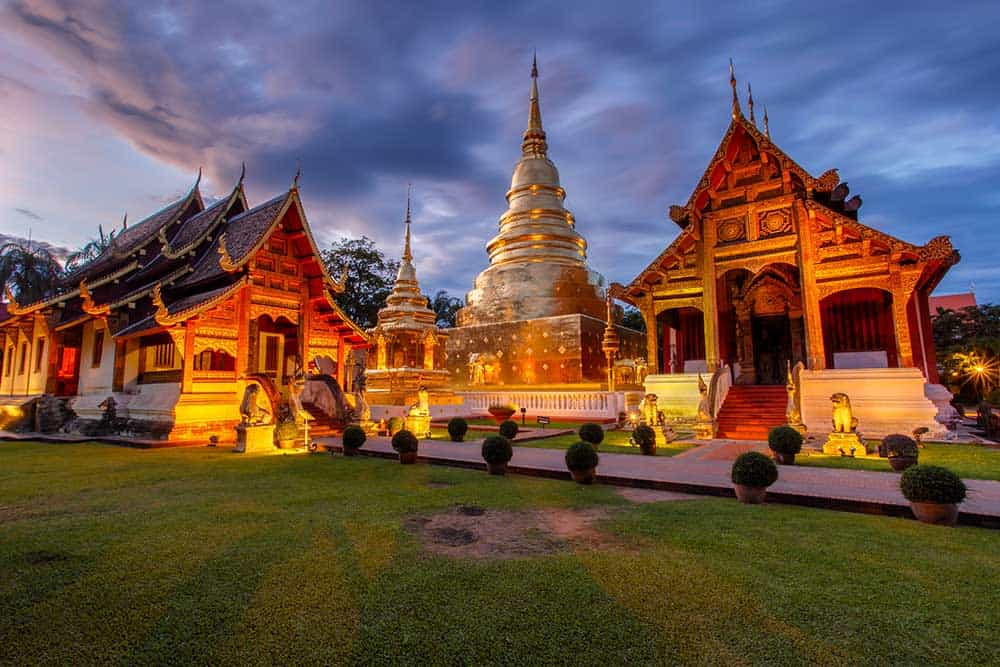
Gina at a Buddhist temple in Mueang Chiang Mai, Thailand (Feb. 2023).
Refuge in the 3 Jewels:
Buddham Saranam Gacchami – I take refuge in the Buddha.
Dhammam Saranam Gacchami – I take refuge in the Dhamma.
Sangham Saranam Gacchami – I take refuge in the Sangha.
Quotes by Sharon Salzberg (from her book, “Faith: Trusting Your Own Deepest Experience”):
I TAKE REFUGE IN THE BUDDHA.
For devotional Buddhists, the Buddha is a refuge because they perceive him as a living energy, capable of providing loving shelter.
The word Buddha (Pali language) means one who has completely awakened from ignorance, one who has fulfilled his or her vast potential for wisdom and compassion.
A human being with human capacities. He asked the kind of questions any of us might ask about the nature of our existence: Born into a human body, vulnerable and helpless. To grow old, get sick and die. To have a human mind that can careen thru anger, joy, lust, pride in the space of a morning? Is there a quality of freedom and happiness that won’t disappear as the conditions of our lives change? It is taught that the Buddha discovered answers not through revelation from a supreme being, but through the power of awareness that is inherent in all of us. For some he is refuge by virtue of this inspiration.
I TAKE REFUGE IN THE DHAMMA.
Taking refuge in the dharma, we are taking refuge in a vision of life that extends beyond our usual, limited sense of who we are and what we are capable of.
The more clearly we see the dharma, the way things are, the more clearly we see the inevitability of impermanence.
I TAKE REFUGE IN THE SANGHA.
The community of those who, throughout history, have sought freedom from suffering and have come to a real and personal awareness of that freedom.
I began to understand that those who are committed to realizing the truth can animate potential within us that might otherwise lie dormant. Taking refuge in the sangha, I could feel the force of life itself.
The voice of the sangha was reminding me that I was not traveling alone.
I am preparing to go on a two-week study-abroad trip to Chiang Mai, Thailand. I am reading more about Thai Yoga Massage and Thai culture. As I daydream, I think about spending time in Buddhist temples. Then I realized I don’t need to travel anywhere to be in a temple – I am a temple.
I am a temple of love. I love chanting in Sanskrit, and I love Buddha’s teachings. I love Buddha and Jesus. However, I am a Yogi and Buddhist. I can’t deny the truth within me.
No matter where I am, I live with an open heart. Also, I appreciate and honor my Buddhist Teacher, Bhante Sati. Thank you, Bhante.
The world and people may seem distant, but it is only temporary. Everything changes. We must have confidence in ourselves. Be a temple of love. A temple is a sanctuary and a place of refuge. Go within yourself to develop a strong mind and an open heart.
My trip to Thailand is a spiritual journey for me. I plan to pray, chant, and connect with the divine. It will be a retreat and training at the same time.
I love you, my dear reader. I may not know you personally, but there is a reason for our connection.
Humans are awakening up to their divinity. A new awakening is arising – just like the sun.
The new humanity will follow in the footsteps of Buddha and Jesus. “The vocation of servant leadership is a call to become as he was in the world – the new humanity, hetero pacificus – the peacemakers whom Jesus called ‘blessed’ in his catalogue of the truly happy people,” Bennett J. Sims said in his book, Servanthood: Leadership in the Third Millennium.
We must strive to become peacemakers with an enlightened mind. “This is meditation. Not taking anything for granted. I mean, we should be grateful and think how fortunate we are that we have this fascinating experience. I call it the laboratory of mind and body. But it seems that though this mind and body are so close to us, they are in many ways so very far away,” Godwin Samararatne said in his book,Discovering Meditation.
Lately, I’ve felt a touch of emptiness in my life. At first, I felt afraid of it. But then, during my meditation, I realized that when something is empty, there’s an opportunity to fill it with something new. I want to fill that space with love, peace, mindfulness, and equanimity.
“So this place of meeting our edge, of accepting the present moment and the unknown, is a very powerful place for those who wish to awaken and open their heart and mind,” a quote by Pema Chodron.
The new human understands impermanence and attachment. I am working on having less attachment in my life. In the last month or so, I’ve had a few challenges in my marriage, and I can see how much attachment I have to my husband.
Every day I remind myself to let love guide me, not fear. I am afraid of losing my husband. But, in reality, everything is impermeant – even my marriage. However, I want to learn more about my relationship with my husband, and I’m grateful that we both want to work on our marriage.
“Buddha’s doctrine: Man suffers because of his craving to possess and keep forever things which are essentially impermanent. This frustration of the desire to possess is the immediate cause of suffering,” a quote by Alan Watts.
The new human has a lot of work to do! But we can transform ourselves into hetero pacificus. To transcend into peacemakers, we need a peaceful and enlightened mind, live in the present moment, understand impermanence, and live every day with love in our hearts.
I just spent four days on a silent meditation retreat with http://www.triplegem.org. Here are 11 lessons that I learned from the retreat:
Be a noble friend to yourself. Take good care of yourself. Remember you are the only doorway to the existence for yourself. During the retreat, I realized that I am too critical with myself. I need to let go of things and be my own best friend.
If you find value in something, continue to pursue it. There are many times that I want to give up on something that’s good for me. For example, sometimes I will find excuses not to go to meditation class.
Watch how your thoughts can cause suffering. Do not be mislead by unguided thoughts or false views. Wisdom comes by seeing the whole picture or the whole story (endowed with insight).
Find commonality among other people. Most people want to improve their lives. We are more alike than different.
Decide to lead a spiritual life, even if that means going through it alone. I realized that most of my family members do not accept that I am Buddhist. My family members are Catholic and they do not understand the Buddhist way of living. Sometimes I feel like I am estranged from my family. However, I know that the Buddhist path is right for me, so I will walk alone if I have to.
Renunciate. In Buddhism, the Pali word for “renunciation” is nekkhamma, conveying more specifically “giving up the world and leading a holy life.” My holy life includes daily practice of yoga and meditation, serving humanity through hospice work, attending a weekly meditation group (sangha) with my Buddhist teacher, sharing metta (loving-kindness) with everyone that I meet, and continuing self-study. I want to increase mindfulness.
Spiritual practices like meditation, yoga, prayer, and reading spiritual literature can help keep you on the right path.
It is important to forgive and move on. “The weak can never forgive. Forgiveness is the attribute of the strong.” – Mahatma Gandhi
Gratitude creates a joyful heart. “Constantly apply cheerfulness, if for no other reason than because you are on this spiritual path. Have a sense of gratitude to everything, even difficult emotions, because of their potential to wake you up.” – Pema Chodron
Use your time wisely. We all have 24-hours in a day. You can create a spiritual life with the right choices.
Never do anything that the wise would reprove (reprimand). We are never alone. There are always celestial beings around us.








 Tunnel Vision 8