
Check out my new article, “Wellness in the Face of Death,” in The Edge Magazine online:
http://www.edgemagazine.net/2018/09/wellness-in-the-face-of-death/
Namaste, world.
Check out my new article, “Wellness in the Face of Death,” in The Edge Magazine online:
http://www.edgemagazine.net/2018/09/wellness-in-the-face-of-death/
Namaste, world.


I have something I want to share. I feel uncomfortable sharing this information, but I am ready to face the situation. Here it goes: My 26-year-old daughter, Brenna, is an alcoholic. It’s hard for me to share this information because of my feelings of sadness and helplessness. I express my love to my daughter as much as I can. I hope that she will get treatment soon and recover. Her dad and I gave her a lot of treatment options. Now she needs to take the next step.
One is addicted…many are affected.
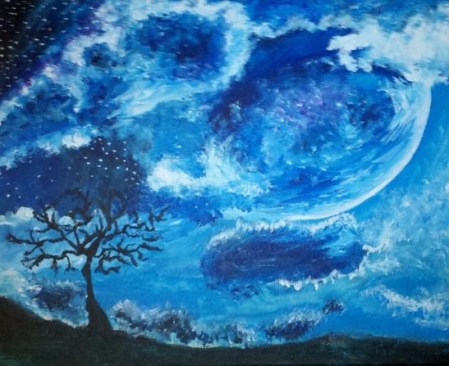
The whole family is affected by alcoholism. It’s a dark cloud, but there’s hope. Behind the dark cloud is a blue sky.
Buddhist monk, Ajahn Chah, says, “Whatever is pleasurable, delicious, exciting, good, is just that much; it has its limit, it is not as if it is anything outstanding.” The monk, obviously, did not have any children. Having a child is truly an outstanding experience. A mother and her child have a strong connection that lasts a lifetime.
When I look at my daughter, I see beauty. Even though she has a severe problem, I still see my beautiful child. It’s easy to judge someone, but as a spiritual person, I honor the spirit within.
I acknowledge that it’s very hard to see my daughter struggle with alcoholism. As a parent, I have so many emotions, dreams, wishes, and hopes for my child.
I want to see the blue sky.
(The photo below is a painting by my daughter, Brenna.)
What can we do when life becomes challenging?
When life is challenging, that is when I learn the most. Can I breathe into the discomfort? Can I be present? Can I allow the discomfort of the situation transform me?
There can be no rainbow without a cloud and a storm. – Ven. Dr. K. Sri Dhammananda
Namaste, world.
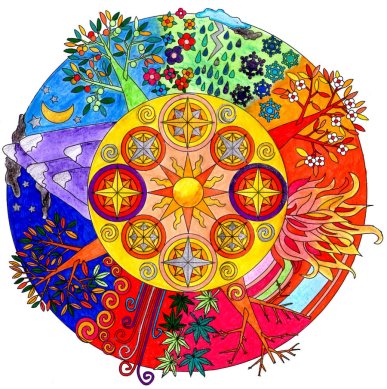 Each person’s life is like a mandala – a vast, limitless circle. We stand in the center of our own circle, and everything we see, hear and think forms the mandala of our life – everything that shows up in your mandala is a vehicle for your awakening. – Pema Chodron
 It’s wonderful to be on vacation. I just spent two and a half weeks in Europe (London, Paris, Venice, Florence, and Rome). Just because I was on vacation, doesn’t mean that I can let go of my daily meditation and spiritual development. I realized that this time away from home taught me some valuable lessons about attachment.
About three days before my vacation was over, I noticed that I missed my house, my dog (Liam), and my kitten (Kira). I know that it’s normal for me to miss my home and pets. But as I laid in bed thousands of miles away from my home, fear crept up inside me. I thought maybe the universe will not allow me to go home. I also thought about refugees who leave their homes behind and I thought about death. When I die, I have to leave my home, pets, and family behind. I realized that I have some very strong attachments.
How can I walk on this earth and not have attachments? Attachments are one of the five causes of suffering called, “kleshas.” Buddhist texts encourage us to cultivate neutrality and equanimity. It’s important to achieve a state called, “chitta-prasadana” – a state of the mind being in a pleased condition. (Swami Veda Bharati, 2015). Even though I was thousands of miles away (4,869 miles to be exact), I needed to be in the present moment – and not “longing” for things; which I found to be a difficult task.
Since I was experiencing fear and attachment, I connected with my breath to help me gain perspective and neutrality. I felt my breath and silently chanted om on the in-breath and shanti on the out-breath. I need to develop my sankalpa – spiritual willpower. A strong mind and spiritual wisdom will open new doors of reality.
Here are some ways to stay on the path according to Swami Veda Bharati (2015):
Om Shanti Om
Namaste, world.
Reference:
Bharati, S.V. (2015). Whole hearted: Applied spirituality for everyday life. Minneapolis, MN: Dhyana Mandiram, Inc. (I highly recommend this book.)

About a year ago, Buddhist monk Bhante Mihintala Kamalasiri gave me a Dharma name. As a Westerner, I do not know the significance of a Dharma name. I know that names are very significant all over the world. A Dharma or Dhamma name is traditionally given by a Buddhist monastic, and is given to newly ordained monks, nuns, and laity. A Dharma name is used to identify oneself as a practitioner of Buddhism.
My Dharma name is: Jinani (Daughter of Rishi). Jinani is also an Arabic name for girls that means “heavenly.” A Rishi is a Hindu sage or saint. A Rishi can also be a yogi.
Just like Native American names, I ponder the meaning of my Dharma name. What does it mean to be a Daughter of Rishi? I am ready to explore this name and its meaning. I realize that the universe has bestowed a new name for me. I am ready to accept the name.
I know that as Buddhist Monks progress in their development, they receive new names. Therefore, there is no need to become attached to a certain name. Therefore, I know that I received the name Jinani for where I am today in my development.
Like I mentioned, I received this name a year ago. And actually, I forgot all about the name until recently. Lately, I’ve become more rooted in Buddhism and in my spirituality. So, maybe it is time for me to recognize the name.
Namaste, world.
*I will be in Europe June 20 to July 6. I will have limited access to a computer, therefore, I will blog after I return.
 Buddhism swings you right out – the First Noble Truth – to look right at pain or unhappiness. It is the same thing as when Jesus said, “Pick up your cross.” We’ve got to bear the cross: the whole symbol of surrendering, rather than using his powers to fly up into the sky. We turn to pain and look right at it, feel it and investigate it: “What is it?” Notice how thoughts say, “This is pain – this is horrible. I can’t take this anymore.” We begin to watch the nature of these ideas that we tack onto the pain: making it my pain, and unendurable.
Mysteriously, once we start to look at pain it changes too, because it’s not a solid thing. So, this is what the physicists are learning: just the act of observing something is actually participating in changing it. By looking at suffering, we’re actually part of the transformation of it. Understanding it, standing under it, bearing with it, we become free from false notions of pain and pleasure. By investigating it, already we see it as something that appears to us, and then dispassion arises. – Venerable Kittisaro
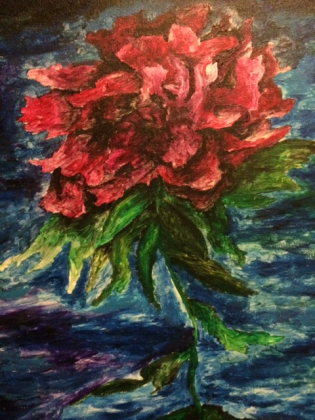
*Painting by Brenna Garens

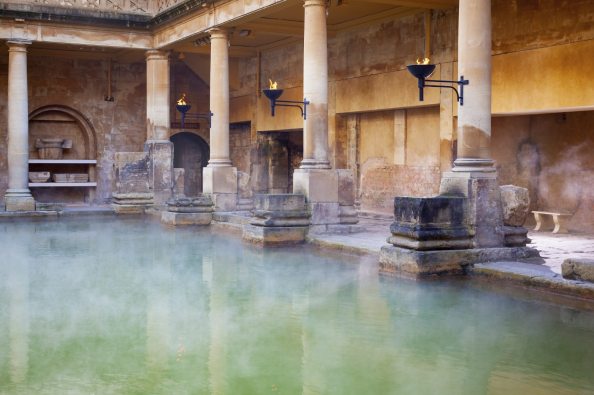 Ancient Roman Bath
I am starting to understand the concept “live in the present moment.” The present moment is all that we have. There is no past or future – only the present moment. I admire people who live each day as if it’s their last.
There needs to be some qualities to living in the present moment. Mindfulness is one of the most important qualities. Be mindful of your thoughts, words, and actions. Also, ritual should be a something created in the present moment. Life is sacred, so we need to honor it. Remember “ritual” is part of “spiritual.”
Each religion has its own rituals, but you can create your own. I do my rituals in the morning and in the evening before I go to bed. In the morning, I do yoga and meditate. I light a candle and burn incense to create sacred space. In the evening, I recite mantras while I sit or lay in bed.
Here is a ritual that I created for one of my classes in the Holistic Health Studies masters program at St. Catherine University in Minnesota:
Personal Healing Ritual: Spiritual Bath
2. Choose the type of bath that you want:
3. How to create the spiritual bath:
Namaste, world.


 Tunnel Vision 8