Facing Loss With Equanimity

angel tear.jpg

My mom tells me that people who cry have big hearts. When we have a loss, the feelings swell up in our hearts, and we cry. Losing a loved is so challenging. Every human being will face loss. My question is: How can we face loss with equanimity? Equanimity means to face a difficult situation with mental calmness and composure. There are different kinds of loss but in this article, I will discuss the loss of a loved one.

We say “hello” to the people and animals in our life, get to know them, and create memories. And then we need to say “good-bye.” It’s an endless cycle of birth and death – like the seasons. This planet is our school. We learn, over time, to have more grace and equanimity in our lives.

One way to create equanimity is to see the world in a different way, have a different perspective. When we understand the nature of impermanence, we know that nothing can last forever. We must instill hope and peace in our hearts to carry on.

I lost a beloved dog a few days ago. It was my brother’s dog, but I took care of it for almost a year. I tried to face this situation with equanimity, but my emotions took over. My definition of equanimity goes beyond having mental calmness. My definition includes having spiritual awareness, mindfulness, and understanding of loss.

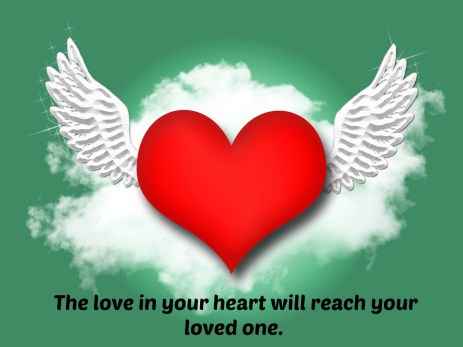
Life is so tragic, but we can create equanimity by remembering how much we love our loved ones. Love is timeless and can cross dimensions on an energetic level. The love in our hearts will reach our loved ones.

winged heart2

I would like to share a simple heart meditation. I  learned this technique in graduate school. It’s from the HeartMath Institute (www.heartmath.org). You can do this meditation with your eyes open or closed. Also, you can do this meditation anywhere and anyplace. There are only three steps:

Step 1: Bring your awareness to your heart. Place your hand on your chest to feel your heart center. Be aware of the feelings in your heart.

Step 2: Take three deep breaths. As you breathe, feel the air pass by your heart center on each inhalation and exhalation.

Step 3: Think of a special place or person or animal that brings you a lot of joy. Bring that moment into your mind’s eye. Play it in your mind like a movie. Feel the emotions of the moment. Feel the joy and love in your heart.

This simple meditation can help you to connect with your heart and your emotions. I hope this meditation lifted your spirits and brought you calmness and joy.

Here are some equanimity key points, by Rick Hanson, Ph.D., “Buddha’s Brain: The practical neuroscience of happiness, love, and wisdom:”

  • Equanimity means not reacting to your reactions, whatever they are.
  • Equanimity creates a buffer around the feeling tones of experiences so that you do not react to them with craving. Equanimity is like a circuit breaker that blocks the normal sequence in the mind that moves from feeling tone to craving to clinging to suffering.
  • Equanimity is not coldness, indifference, or apathy. You are present in the world but not upset by it. The spaciousness of equanimity is a great support for compassion, kindness, and joy at the happiness of others.
  • In daily life and meditation, deepen your equanimity by becoming increasingly mindful of the feeling tones of experience and increasingly disenchanted with them. They come and they go, and they’re not worth chasing or resisting.

Namaste, world.

calmness


The Friendly Afterlife

afterlife1

I have some good news to share: The afterlife is friendly. A week ago, I spent some time with an elderly hospice patient. As she lay in her hospital bed, she dozed in and out of sleep; transitioning to her new afterlife. As a witness, I stayed with her, without talking or moving. I watched her; as if I was waiting for something. Then it happened. She opened her eyes and stared up towards the ceiling of her bedroom. Her eyes stared at one thing. Then she closed her eyes. A few seconds later, she opened her eyes again and looked at the same spot. Then she closed her eyes. The third time she opened her eyes, looked up at the same place, and smiled. It was the most peaceful and child-like smile I have ever seen. After she had smiled, she continued to look up towards the ceiling, and then she waved her hand as if to say “Hi.”

After this experience, I have come to the conclusion that the afterlife is friendly. My hospice patient has no fear. She is at peace as the veil between her current life, and her afterlife becomes more transparent. Soon she will leave her body and be on a new journey. The human body that she has will never exist again.

As I sat in a wooden chair next to her hospital bed, I glanced over at her black and white wedding picture that stood on her desk. She was a beautiful young woman. She had a heart-shaped face and smooth skin. Her husband wore a navy uniform and slick-back hair. After looking at her wedding picture, I looked back at the old woman with white hair and tried to imagine her young again. As I stared at her, I noticed that she was still very charming. She had the prettiest grayish-blue eyes that are haunting – but in a good way.

I became my hospice patient’s volunteer only two months ago. At my first visit, I realized that my patient was close to death and not talking as much. Therefore, I do not know her that well as a person.

The aide in the hospice house said my hospice patient was always so polite and thankful when she was able to talk. She always said, “Thank you, dear” to all the staff. Her elegance and grace are still with her even as she is dying. I learned in my hospice training that people die the way they have lived.

I do not know who my hospice patient saw as she looked up at the ceiling. I have heard many stories of people, who are close to death, seeing relatives or guiding spirits. I am honored to have experienced this spiritual connection as I sat with my hospice patient. I know in my heart that dying is a friendly and peaceful experience.

I see myself in my hospice patient. I know that this, too, will someday be my reality. Sometimes, in a warped sense of time and reflection, she is me. And when I reflect on this, I have no fear.

Namaste, world.

Anais-Nin

A New Worldview of Health

paradigm-shift22

“Health is a state of balance in which your life is defined by purpose, freedom, growth, and joy.” — Christiane Northrup

Balance is vital to health. When my balance is off, I can become ill. For example, if I feel a cold coming on, I have two choices: I can rest my body or keep pushing myself. I think it is important to listen to my body. Johnson (2005) encourages “people to listen to the messages of their flesh, to embrace their breathing patterns, to follow their styles of moving, and to pay attention to the insights that emerge within the movement itself” (p. 114). There are messages sent to the body every second. It is a choice to listen to the messages or not.

Health

My mother always tells me that if I do not have my health, I have nothing. Health is a gift (illness can be a gift too – see the next paragraph). Adams (2011) states, “Health is obviously so much more than a disease-free interlude. To be healthy is to have a body toned to its maximum performance potential, a clear mind exploding with wonder and curiosity, and a spirit happy and at peace with the world” (p. 190). This quote from Adams aims for perfection, but health is more like a roller coaster. It is impossible to stay in one state of health for a whole lifetime. Health will ebb and flow. The nature of the human being is to experience impermanence. Every person will experience illness at some point in his or her lifetime. Again, these experiences are impermanent. You cannot stay sick forever.

Illness

I am a little afraid of getting sick. About eleven years ago I was swimming in the ocean and a huge wave crashed my head down to the ocean floor – like getting hit in the head with a baseball bat. That following evening I became very nauseous and I started to vomit. I went to urgent care the next day, was diagnosed with a awful case of vertigo, and was given medicine. I could not stand on my own two feet, for even a few seconds, without the room spinning around and around.

I was not ill in the sense of getting a virus or a disease. However, a blow to my head caused me to become very ill. And what scares me the most: something, like an accident, can cause illness. It is the unpredictability of life. However, through the years, I have learned to trust the universe.

Vertigo has made me understand the difference between health and illness. It took about seven days for me to recover fully from vertigo. I understand my body a lot better now, and I know what I need to do if I feel vertigo symptoms coming on. I am prone to getting vertigo because of the head injury. I have to be careful not to hit my head, and I have to keep my ears from getting plugged when I have a sinus infection.

This vertigo experience has shown me great respect for the mystery of life, and I have a lot more patience. I have gratitude every day. I love my life!
let_s_love_life

Illness can be a great teacher. If I did not get vertigo, I might have taken my life and health for granted. Now I see my health as being very precious. Dossey (2011) adds, “Although the illness varied, the message was often the same: The disease led to an increase in wisdom and understanding and held lessons that paradoxically made life better” (p. 143).

Wellness

Meditation is very crucial to cultivate wellness. My Buddhist teacher ends every meditation session with this saying: May all living beings be well, happy, skillful, and peaceful. When I am well, I feel lightness in my physical body, a clear mind, and an abundance of energy. When I am happy, I feel joy searing through my heart. When I am skillful, I have a purpose in my life. When I am peaceful, I feel no fear.

Meditation brings my attention back to my inner world. I gain awareness of my whole self. When I meditate, I focus on my breath and let the thoughts come and go without attachment. If I start to think too much, I bring my attention back to my breath. Venerable Ajahn Chah (1992) beautifully adds, “Getting lost in some train of thought won’t lead you to the truth, it’s not wisdom” (p.48). Wisdom is higher consciousness and self-knowledge. Wisdom is seeing the true nature of all things. Meditation fosters understanding.

The New Role of the Healer

I am so thankful for the integral theory and the new role of the healer. According to Ken Wilber (2005), “An integrally informed medical practice changes the practitioners first; they can then decide which of the treatments – conventional, alternative, complementary, and/or holistic – they wish to utilize, individually and collectively when practicing medicine with integrity” (p. xxxi). Several years ago I was in a very stressful job, and I started to feel sick. I had cycles of panic attacks, and I had a touch of vertigo. I put the integral theory into practice, without knowing it at the time. I saw my family physician for medication, had an acupuncturist balance my meridians, and I went to a massage therapist to reduce my stress. I was back to feeling balanced in a couple of weeks after seeking treatment.

Wilber writes a lot about the “wholeness” of the healer or practitioner. The transformation of the practitioner is essential. And, according to Wilber (2005), that “integral medicine goes one step further: it treats the illness, the person, and the physician” (p. xix). The caregiver is a big part of wellness. I so am thankful for the integral theory and the new role of the healer because it is change the world needs so desperately.

The New Role of the Client/Patient

I experienced the empowering new role of the patient. When I was pregnant with my second child, I developed high blood pressure at the end of my pregnancy. My doctor insisted that I get admitted to the hospital immediately (that night) and begin Pitocin to start my labor. Pitocin did not work very well for me during my first pregnancy, so I was against it. I told my doctor, “No. I am not going to the hospital.” For first time, I told a doctor “no.” I explained to my doctor that I wanted to get acupuncture treatments to start my labor. And that is what I did. I went on a Saturday morning for an acupuncture treatment and then again on Monday morning. I went into labor on Monday evening. I trusted myself. And back then, about fifteen years ago, I was practicing self-advocacy. I took responsibility for my health and the health of my unborn child. Hunter Adams (2011) states, “Health results from an active participation that only the self can give. The health professional’s role then shifts from that of a mechanic fixing the breakdowns to that of a gardener nurturing growth” (p.190). It was scary telling my doctor “no.” I stood up to a strong authority figure in our society. I felt empowered when I took my health into my hands.

Paradigm Shift

In the old paradigm, the patient gave all the control of his or her body to the physician. Dr. Northrup (2003) experienced this old model in her practice. She said that she asked a woman to tell her what was going on with her body and the women replies, “You tell me. You’re the doctor” (p. 431). Patients in the old paradigm believed that getting sick was just bad luck and that they did not have any control over the situation. In the old paradigm, the doctor-patient relationship is similar to a parent-child relationship. Dacher (2005) adds, “The science and particularly the medicine associated with this viewpoint have taught us to seek the remedies for our problems outside of ourselves, to distrust our inherent healing capacities, and to look towards the professional as the singular authority on issues of health and healing” (p. 19).

The new paradigm shift to self-advocacy will become the norm. A team of professionals and the patient will work for the common good of the patient. The professional or practitioner may incorporate other healing modalities that are not traditionally within his or her modality. Healing and medicine will be inclusive.

Healer as a Social Activist

Health and wellness are not equal in all parts of the world. Socio-economic factors do affect health. People who live in poor communities suffer from greater ill health and shorter life expectancies than those who live in developed communities. Also, many individuals who live in poor communities do not have the best healthcare. Poverty creates a cycle of poor education, social exclusion, and mental/physical breakdown. Dr. Thompson (2012) offered this perspective:

“Our view of social healing assumes a relatedness between individual and collective wounding and healing. Unresolved historical wounds carried in the collective memory, and collective unconscious can, and do, trigger a complex array of conflicts. This transference from generation to generation of victim-perpetrator dynamics often result in violent confrontation, war, oppression, human rights abuses and terrorism.”

Every human being is a healer. As shown in the film, “Roots of Health,” regular people can get together to create change and facilitate healing in their community. The film started with depressing images and sad stories. But by the end of the movie, I understood that change can happen. Thompson (2012) concludes with this:

“We are on the edge of an evolutionary phase shift and that ultimately healing is about evolution. We can’t heal without evolving. Thus social healing finds its highest calling discerning the information coming through at the edges of the new worldview and translating that into language, maps and tools for healing the historic wounds that have held old worldviews in place.”

Conclusion

Awareness leads to transformation and a new worldview of health. Health is a state of balance but there many factors contributing to health and illness. Listening to the messages of our bodies is important. Awareness is the starting point for health and wellness. However, to go further and ignite transformation, we need to invite the new paradigm shift in the new role of the client and the new role of the healer. This new paradigm shift will heal our historic wounds and guide the new healer as a health activist to create new ways to heal the world.

Namaste, world.

heal the world1


References

Adams, H. (2011). Foundations of complementary and alternative medicine. St. Louis Missouri: Elsevier, Churchill Livingstone

Chah, V. A. (1992). Living Dhamma. Thailand: The Sangha, Bung Wai Forest Monastery

Dacher, E., Johnson, D. & Wilber, K. (2005). Consciousness & healing: integral approaches to mind-body medicine. St.Louis, Missouri: Elsevier, Churchill Livingstone

Dossey, L. (2011). Foundations of complementary and alternative medicine. St. Louis Missouri: Elsevier, Churchill Livingstone

Northrup, C. (2003). Voices of integrative medicine: conversations and encounters. St. Louis Missouri: Elsevier, Churchill Livingstone

Thompson, J. & O’Dea, J. (2012). The social healing project. Retrieved from:  http://www.servicespace.org

The Meditation Challenge

Challenges

This past week I went on a 4-day silent meditation retreat. It was the hardest retreat I have ever been on. I was challenged on every level – mental, spiritual, physical, and emotional. After the first full day, I wanted to leave. My suitcase was packed and I was planning to leave early in the morning.

Then I stopped. I realized that I always run from things when the “going gets tough.” I decided to stay for the whole weekend. I had several friends at the retreat and I wanted to fulfill the commitment. I instilled in my mind a resolve and stayed.

This retreat was like a meditation boot camp. We were on a strict schedule; which wasn’t my plan going into the retreat. I was looking forward to some meditation and a lot of relaxation. Instead, I had to wake up every morning at 5:00 and be sitting on my meditation cushion at 5:30. The days repeated with the same schedule: chanting, group meditations, walking meditations, yoga class, and teachings of the Buddha. I led the yoga classes.

TGN

This retreat reminded me of a sweat lodge experience I had about 18 years ago. I was invited to an Native American sweat lodge. It was an honor to have that experience. A good friend of mine had connections with a Native American tribe. Before the sweat, my friend educated me about the sweat lodge rituals. I had to prepare my body by fasting one day before the sweat. I also made tobacco prayer bags to hang in the sweat lodge. I remember creating the tiny bags and dedicating each one to my family members and friends. Before the sweat began, I gave the Native American elder a bag of tobacco as a gift.

sweatlodge

The sweat lodge experience and mediation retreat were similar because of the challenge. Each experience challenged my whole being. It was difficult to stay and not flee. In the sweat lodge experience, I had to connect with my breath – just like sitting in meditation. The thick, hot, moist air forced me to go inward and focus on my breath. Also, in each experience I had to overcome the obstacle of fear. In the sweat lodge, I feared dying because I could hardly breathe. I remember laying down in a fetal position and putting my face to dirt floor so I could breathe better. I prayed to God that I would survive. The Native American elder helped me to stay connected with my inner journey as she chanted with the drum. In the mediation retreat, I feared losing my mind or fainting from sitting too long. The second morning of the retreat I sat in a group meditation for about two hours. As I sat, tears rolled down my cheeks. I couldn’t help but cry. My hips and legs hurt, my mind was swimming, and I was grieving the loss of my dad (he has Alzheimer’s disease).

After wiping my tears, I acknowledged my emotions and refocused on my breath. After this moment, I felt better. I changed the position of my legs and I sat with clarity and focus. My body felt lighter and my mind tranquil. I had overcome one of my toughest challenges during the weekend.

I also survived the sweat lodge experience. Each of these experiences created a new me – I was reborn. The sweat lodge is round, wet, and warm like a mother’s womb. The large, round rocks that baked all day in the fire pit warmed the lodge. Water was poured onto the rocks and my body sweat like it was raining. The heat scorched my body and my heart beat along with the drum. I laid in a fetal position trusting God and the Universe. Several hours later, the flap lifted and fresh air rushed in. I stepped out of the sweat lodge wet and slimy like a newborn. The cool, fresh air refreshed my body, mind and spirit. I felt a sense of accomplishment and gratitude filled my heart.

I was reborn after the meditation retreat too. I am a different person because of the meditation challenge. This challenge created determination and resilience inside me. Now I must go forward and remember keep my light shining bright…because I am radiant and strong.

Namaste, world.

“Let everything happen to you: beauty and terror. Just keep going. No feeling is final.”   — Rainer Maria Rilke

energy body

The Divine Massage

divine massage

While I was in India in January 2015, I took the opportunity to get a one-hour, full body Ayurvedic massage. I am so glad that I took the time to get a massage in India. I spent two weeks in India learning about Ayurvedic medicine. I received a Ayurvedic massage in Rishikesh. This experience created a whole new level of understanding. I will never forget it.

I paid one thousand Rupees which equals to about $16.00 U.S. dollars. After I paid the money, I followed the therapist to a therapy room. The spacious room had a massage table, chair, stool, and a cabinet against a wall. The room was lit by two high windows and a floor space heater keep it warm. (It was cold in northern India!) The cream-colored room was spacious with no pictures on the walls or decorations. The massage table was a heavy, dark brown wooden table. It had deep, open grooves along the sides to collect the oil. A Shirodhara oil container hung at the end of the table. Shirodhara is a therapy that involves pouring hot medicinal oil over the forehead.

The Indian massage therapist looked to be in her late forties. She was short and sturdy with a medium build. She had brown beady eyes and a crooked smile. She wore her long black hair in a pony tail and she wore loose pants and a kurta (long shirt) with an apron. She spoke little English.

I undressed in front of the therapist. I undressed and folded my clothes and put them on the wooden chair. I felt vulnerable as a stood there naked from head to toe. The therapist wrapped a thin towel around my trunk and pointed to the wooden stool. The space heater was near the back of the stool. I sat on the stool while the therapist rubbed my scalp with warm oil. The oil was pungent and smelled like burnt cooking oil. The therapist continued to rub my head, neck, and shoulders.

In the U.S. we do not undress in front of the massage therapist. Americans are modest; especially Minnesotans. In India and in many other Asian countries, there is no modesty when you get a massage. Furthermore, there is no medical history intake form or waiver to sign.

After the upper body massage, the therapist helped me lay face up on the hard, wooden table. The heater near the end of the table was making my feet feel like they were marshmallows roasting on a fire. I moved my feet to the sides of the table indicating to the therapist to move the heater – which she did. A thin, hand-towel-size cloth draped over my trunk. The sides of my breasts peeked out from towel. I readjusted the towel but it was no use! I gave in exposure! The therapist massaged my whole body with lotion and warm oil. She started with a gentle face massage with lotion. Then she massaged my legs, inner legs, arms, stomach, and then my breasts with warm oil. This was the first time I ever had a breast massage. It felt awkward at first but then I just relaxed. I know it’s healthy to massage the breasts. Massaging the breasts moves the lymph and create healthy circulation.

When I turned onto my stomach, hot oil poured on my back. It felt wonderful! This was divine! The massage therapist climbed onto the table to use her weight to massage my back. I could feel and hear my back crack as she went from my neck to my hips and back up from my hips to my neck. She also poured hot oil in my butt crack!

After the massage, the therapist sat me on the table and used the towel to wipe off the extra oil. The massage was over. The therapist cleaned the table as I got dressed.

body

This Ayurvedic massage was different from Western massage. I felt like it was an oil bath! I felt good and oily afterwards. According to Vasant Lad (popular Indian author and Ayurvedic doctor), during an Ayurvedic massage, “oil is applied to the entire body with a particular kind of massage that helps the toxins move toward the gastrointestinal tract. The massage also softens both the superficial and deep tissues, helping to relieve stress and to nourish the nervous system.”

Oiling is important in Ayurveda to calm the mind and nourish the body. It also improves circulation, prevents dehydration, strengthens the nerves, and creates an electrochemical balance in the body. Ayurveda massage uses large amounts of oil. According to Swami Sada Shiva Tirtha (American Swami and author), “As with all Ayurvedic abhyanga, the main emphasis is on feeding the skin rather than on massage techniques. Oil penetrates the skin, all the tissues are fed, and the toxins contained within the tissues are released.”

As a massage therapist, I took special mental notes during my Ayurvedic massage. The therapist used long strokes and compression – like a Swedish massage. After the massage, I realized that it’s the oil that made the Ayurvedic massage so special. The hot oil electrified my skin. There is an electrochemical connection with the hot oil and the skin. It’s divine!

Namaste, world.

massage

Journey II

cosmic egg

Lately, in my life, I’ve taken more time for meditation, yoga, and day dreaming. I’ve found that my life is much more richer. I enjoy contemplating life. I just want to ponder about life and the universe. I remember being in India and observing the sadhu. The sadhu is a religious ascetic or holy person. According to Wikipedia, an ascetic describes a lifestyle characterized by abstinence from worldly pleasures. A sadhu can be male or female. Females are, “sadhvi.”

Most sadhus engage in some form of religious practice: devotional worship, practice hatha yoga, bestow religious instruction and blessings to lay people, counsel families or intervene in disputes between individuals.

The sadhus that I observed in India sat and meditated. Some sadhus engaged with people or animals on the street. Most of them were silent. It is common for them to remaining silent for years.

I realize now that, while I was in India, I never took pictures of the sadhus. I respected them and I left them alone. I was curious about them but I didn’t know how to engage with them.

I will never be a sadhvi in my present life. My lifestyle is different. I live in a country that doesn’t support holy people on the streets. This country lives in a different reality.

I can live my own spiritual life. I practice meditation and yoga. I can help others through teaching yoga and doing massage therapy. I can create space for contemplation and imagination. One way that I foster my imagination is through a type of meditation using the repetitive beat of the drum. This is a shamanic journey.

I decided to do another shamanic journey. The purpose of this journey is to get in touch with my imagination. I had set out to explore a fairy tale but the journey took on a different direction.

I laid down on the floor and listened to a recording of drumming for about 30 minutes. My entry port was Lake Waconia. I started out seeing the wooden dock that extended out into the lake. As I looked out, I saw sail boats and fishing boats in a circle leaving a spot in the middle open. The fishermen and people looked at me and pointed to the open spot in the lake. It was a cloudy day with billowing clouds in the sky.

I saw the spot that I should jump into. I ran on the dock towards the spot in the lake. I jumped off the dock and did a somersault before I landed in the water. As I sank I immediately turned into a mermaid. This time I had long orange hair and a green tail. I swam in circles until I noticed sharks making a wide circle around me. They paused as they watched me sink deeper and deeper. I saw the door on the bottom of the murky lake. I tugged on the latch but it would not open. The sharks started to get closer so I tugged again and I finally opened the door.

The door opened to cosmic space. I floated in space as I curled up into a ball; creating a spiral with my body. I transformed into embryo-like creature. I floated in space twirling around and around. Then I saw planet earth in the distance. I floated to earth.

As I floated toward earth my body transformed back into a mermaid. I landed on the forest floor and my tail turned into beautiful human legs. I was myself with a long cream-colored dress and pearl-colored cape. I was in the woods at dusk. I was not afraid. A creature floated down from the sky and landed in front of me. This being was cosmic with light and some form. He had a draping cloak with a hood. He was taller than me and I could not see his face. He told me that I was not going to explore the fairy tale. This journey wanted to show me something else. He said his name was “Mufa.” He was the teacher of imagination. I asked him if I could see his face and he told me no.

Mufa was a kind being. I was not afraid of him and I felt like I have known him all my life. He held my hand and told me that he has a gift for me. He led me to tree stump and opened the top half of it like a lid. Inside the tree stump was a box. The box changed shape several times until it became a long rectangular box. I opened the box and again the contents changed until it settled on a glowing cosmic egg. Mufa held the cosmic egg up to my eyes. I could see the swirling energy glow inside it. He told me this is the gift of imagination. He drew three lines on my palms and then he placed the cosmic egg in my mind.

Mufa took my hand and we floated up to the sky. We held hands and danced in the sky. Mufa said the key to exploring life is the imagination. Our ancestors knew the secret of imagination. Mufa asked me, “What do you want?”

I told Mufa I would like to explore my imagination and then write about it. I also told him that I would like to travel to spiritual places and then write about my experiences. Mufa took my hand and we floated back down to the forest.

Mufa said that we need to use our imagination to see things in a different way. He asked, “Why do we always have to look up to see the sky?” He used his magic and imagination to open up a window on the forest floor. As I peered down I could see the blue sky with puffy clouds. We took hands and jumped into the sky and fell down fast…like sky diving. Mufa asked me where I wanted to go. I told him let’s visit the pyramids. Soon the pyramids were in the distance and we floated to them. We landed on the ground and I reached out to touch the stones of the largest pyramid.

The journey ended with the called back of the drum. I traveled back into space, up through the door, and back to the surface of the lake.

———-

I believe that sadhus have imagination; they see the world with different eyes. They are very brave souls. They are not afraid.

Namaste, world.

tree

“To get beyond the wall of mirrors, the final challenge is to pass through a tiny door. To do this, we must make ourselves very, very small. To be humble. Then we must burrow down into the Earth, where indigeneity lives. On the other side is a clear pond. There, for the first time, we’ll be able to see our true reflection.” — Kenny Ausubel


Journey I

mermaid

How can a modern person be spiritual? There are many obligations to modern life. There are bills, children to raise, aging parents to help, chores to do, etc. How can one retreat to daydream and ponder life?

Right now, in my life, I need to retreat and go inward. I wish I was in ancient times where I could spend time in a forest or climb to the top of a hill or mountain to reflect. My wise ancestors spent time in the forest and in caves to meditate. Sometimes I wish I was in simpler times.

My Buddhist teacher, Bhante Sathi, said that it doesn’t matter what time you live in. Every time period has its struggles and challenges. He said it’s essential to train your mind – this is urgent. He told a story about his neighbor. His neighbor was busy and she said she didn’t have time to meditate. She wanted to meditate but she filled her day with other things. Then she found out she had cancer. All the other “things” didn’t matter anymore. Things are like large balloons. They are big and appear to be special but filled with nothing. It is important to set our priorities. We all have the same 24 hours in a day. What is important to you?

I decided to find answers to my questions by doing a shamanic journey with a recording of drumming on my iPod. According to Wikipedia, “Shamanism is a practice that involves a practitioner reaching altered states of consciousness in order to perceive and interact with a spirit world and channel these transcendental energies into this world.” Shamans are in every culture around the world.

I have done many shamanic journeys before. I use it as a tool to dig deeper into my subconscious mind. Sometimes I get answers and sometimes I do not. The journey taps into my imagination.

I did a 15 minute shamanic journey. My journey started out on a wooden dock that extended out into Lake Waconia – where I live. I have used this entry point many times. I ran on the dock toward the water and jumped into the lake. I allowed myself to sink to the bottom of the murky lake. One harmless shark swam by me. I found the latched door at the bottom of the lake. It was square-shaped and made of rusty metal. I opened the door and found myself in another body of water. This water was deeper and clearer. The water was blue with small fish swimming around. As I sank a little deeper I noticed that I was a mermaid with long blonde hair and a blue tail. It felt natural for me to be a mermaid. Then all of a sudden I was trapped in a large glass box. I could see all around me but I was stuck in a square box. I put my hands on the glass. I needed to find a way out. I found another square latched door at the bottom of the glass box. I opened it and I entered space. I was floating in space and I was formless. I could see the stars in the distance and the milky way. I was suspended in space. I was stuck, again. I felt calm but I also felt an urgency to keep moving.

I stayed in space thinking my journey was over. I accepted the fact that maybe this was all that I was to see and experience. Then I saw a portal…a tunnel. I floated towards to the portal and I was pushed down into the spinning tunnel. Then I was dropped into a new world. This world looked a lot like earth. The only difference was the buildings were oblong and metal.

oblong

One grey alien greeted me. He wanted me to come into one of their oblong buildings. I followed him into the building and he had me sit in a chair that was a simulator. There were other aliens standing around me. They were about to hook me up to the simulator but I became fearful and I jumped up and ran out of the building. Through mental telepathy I told them wasn’t ready to continue. They let me go.

I ran up the hill to a hobbit-like home. It was a simple house with earth all around it. I have been to this house many times in shamanic journeys. This was where my spiritual guide lives (one of them). I opened the door and sat at usual kitchen table. The home was comfortable with simple wooden furnishings, candles, and a wood stove. My guide sat across me. She is an older woman; a reflection of myself in old age.

She held both of my hands in her hands. She had kind eyes. She asked me, “What do you want?” I told her that I am struggling to find time to be spiritual in my present life. She told me that time is an illusion. I have plenty of time. She also told me there is nothing to possess…only being. She told me to keep going. I was on the right track.

I could sense that my time was up. I was waiting for the call back in the drumming. My guide asked me if I wanted to dance to the drumming. So while holding hands I danced with my guide until it was time for me to go. Once the drum beat changed I headed back up; the same way I came down. I left the hobbit house, passed the oblong buildings, went up the tunnel, and went into space. Then I opened the latched door to the first body of water, then opened the second latched door to Lake Waconia. I emerged from the water and found myself back on the wooden dock. My journey was complete.

My guide said time is an illusion and I have plenty of time. So back to my questions: How can a modern person be spiritual? How can one retreat to daydream and ponder life? Each person has a unique life and unique circumstances. In my own life, I need to set priorities. My priorities include mediating every day. According to my Buddhist teacher, when we die we lose everything…except our mind. Therefore, we need to exercise our mind.

There is a lot of symbolism in shamanic journeys and dreams. My mentor who is a Franciscan Sister said that it’s important to have someone help interpret the meaning of the dreams. It’s good to get an outside perspective. We may have clouded judgment or we may not “see” what another person sees.

I still have a need to retreat to meditate, daydream, and ponder. I decided to go on a solo hermitage retreat. I will stay in a small one room cabin for the weekend. I will have no technology with me. I will eat simple foods and journal with a notebook and a pen. I will have no contact with the outside world. I will recharge and reconnect with nature.

Namaste, world.

journey

“The new psychologies of hypnotic suggestion and ‘creative visualization’ are increasingly aware that we are capable of infinity more than the assumed constraints of ‘physical laws’ on our bodies and minds would have us believe.”  – Lawrence Blair

Eagle’s Perpective

golden eagle

I had a fantastic dream last night. I dreamt of a giant eagle. This eagle was not a bald eagle. His feathers were dark brown with specks of white and the feathers around his neck were golden brown. He was a giant golden eagle with a wingspan of about 60 feet.

The giant eagle was searching for something. He was unhappy living in a small, dull village nestled by valleys and hills. He said the people there had no imagination. He, himself, only flew low to the ground. As he spread his eagle wings he would crumble the sides of the buildings as he approached the village. He lived on the ground and he had his own giant house with a curved driveway in the front. He would sit on his driveway and think.

One day he realized something: He was the one who lacked imagination. He was afraid to go to high ground and see a different perspective. He was capable to fly high – but he never did. God gave him all the tools to fly; large wings and excellent eyesight. But his fears held him back.

Finally, one evening he decided to be brave and fly high. He spread his large wings and flapped and flapped until he was high into the sky. Soon he was flying high and fast. He never experienced such exhilaration! He looked ahead in the distance and he could see a sparkling city. It twinkled like the stars at night. It was a giant city with tall buildings and buzzing energy. He didn’t know a place like that existed. He was never brave enough, until now, to fly high enough to see something new.

The giant eagle decided to leave the small, dull village and venture to the new magical city. He restored his hope and he reached his full eagle potential.

Then I woke up. I said to myself, “That was an awesome dream!” I thought about my own life and how I need to reach higher ground to get an eagle’s perspective. My life may seem daunting at times. But if I can see the larger picture…an eagle’s perspective, there may be things that I didn’t know about that may help me.

Here are some questions to ask yourself: Are you flying too low? What fears are holding you back? What is keeping you from exploring your imagination? Are you reaching your fullest potential? How would your life change if you changed your perspective?

————-

According to Wikipedia, ” The golden eagle is regarded with great mystic reverence in some ancient, tribal cultures.” Wikipedia continues to explain that the Aetos Dios was the “Eagle of Zeus” in Greek legend. Aetos Dios was a giant, golden eagle. He served as Zeus’ personal messenger and animal companion. According to some, the eagle was once a mortal king named Periphas. His virtuous rule was so celebrated that he was like a god.

eagle

In native cultures around the world, eagles are considered medicine birds with impressive magical powers, and play a major role in the religious ceremonies of many tribes. To learn more see the link: http://www.native-languages.org/legends-eagle.htm

Namaste, world.

native american

Spirituality & Caring for the Dying

lotus

“Death is not the opposite of life. Death is the opposite of birth. Life is the continuum of birth and death.” — Deepak Chopra

Many people have done little work to prepare for death on a psychological, spiritual, and social level. Why do we fear death so much? How can spiritual practices prepare us and aid us in the dying process? These are profound questions that are important for us to consider for ourselves and our loved ones.

According to Murray, Kendall, Boyd, Worth, and Benton (2004), “Spiritual needs are the needs and expectations which humans have to find meaning, purpose and value in their life. Such needs can be specifically religious, but even people who have no religious faith or are not members of organized religion have belief systems that give their lives meaning and purpose” (p. 40). Defining spirituality and spiritual needs can be difficult because each human being has their definition. Edwards, Pang, Shiu, and Chan (2010) add, “A crucial question is whether or not patients themselves recognize the concept of spirituality as defined by healthcare professionals. Patients may not understand the term ‘spirituality.’ What professionals assume to be spiritual care might not correspond with patients’ understandings and needs” (p. 24). There are several barriers to spiritual care such as personal, cultural, institutional, and educational needs of professionals.

What are some of the spiritual needs of patients? The main spiritual needs are 1. The need for closure (finish business and reconciliation). 2. The need for involvement and control over daily activities. 3. To remain involved with family and in decisions about their lives. And 4. Need to for a positive outlook (happy thoughts, to see the smiles of others, humor, and laughter).

My grandmother died this past July. She was 94 years old. I knew that she was dying, but I did not go to her bedside to say, “Good-bye.” Now I regret not going to see her. I was not there but I know my grandma loves me, and I love her – this is all that matters.

grm theresa Grandma Theresa

I grew up in Catholic religion, but now I am a Buddhist. I consider myself a Catholic Buddhist – if there is such a thing! In the Buddhist tradition, according to Hawter (1995), “It is emphasized strongly that the time to prepare for death is now, because if we develop and gain control over our mind now and create many positive causes we will have a calm and controlled mind at the time of death and be free of fear” (p. 3). The way to a calm and controlled mind is through meditation. Meditation trains the mind like running trains the body. Also, in the Buddhist tradition, it is important to die with a calm and peaceful mind.

How can spiritual practices aid the patient in the dying process according to the Buddhist tradition? If the patient is conscious, then he or she can do the practices with his or her family, minister, or spiritual counselor. If the patient is unconscious, then the family/minister/spiritual counselor will recite prayers or mantras into his or her ear. Hearing is the last sense to be lost. It is important to do whatever reminds the patient of his or her spiritual practice. It is beneficial to have spiritual objects around the dying patient (for example an altar, a rosary, photos of the spiritual teacher). Playing spiritual music, burning incense, and singing songs can also help calm the patient.

For patients that are in advanced illness but are still conscious benefit from simple meditation techniques and visualizations. Also, a gentle massage, Reiki, aromatherapy, or reflexology can be soothing and stress-relieving. Again, it’s important to help the patient have a peaceful mind as they approach death.

We do not need to fear death. Actually, according to Reagan (2013), “We are discovering that simply contemplating death can make us happier, healthier, and better citizens…as we confront our mortality, we are midwifing the difficult birth of a multidimensional transformation – physical, spiritual, psychological, social, and ecological” (p. 38).

Namaste, world.

healer

References

Edwards, A., Pang, N., Shiu, V., & Chan, C. (2010, winter). The understanding of spirituality and the potential role of spiritual care in end-of-life palliative care: a meta-study of qualitative research. Palliative Medicine, 24(8), 753-770

Hawter, P. (1995, August). The spiritual needs of the dying: a buddhist perspective. Retrieved from: http://www.buddhanet.net/spirit_d.htm

Murray, S., Kendall, M., Boyd, K., Worth, A., & Benton, T. (2004, January). Exploring the spiritual needs of people dying of lung cancer or heart failure: a prospective qualitative interview study of patients and their careers. Palliative Medicine, 18(1), 39-44

Reagan, L. (2013, winter). Death makes life possible: bridging consciousness, science, and spirit. LILIPOH, 18(70), 36-40